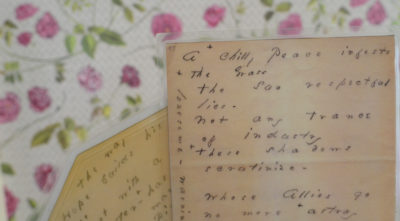
Emily Dickinson's handwriting on a letter and envelope

Poetry Discussion Group Spring 2025 Series

Emily Dickinson's handwriting on a letter and envelopeJoin us for a lively virtual discussion of Emily Dickinson’s poetry and letters, meeting once a month from March to June. This program is designed to welcome newcomers and seasoned readers of Dickinson alike. 

Each session is facilitated by a guest scholar with unique expertise, who leads the group in discussion following an introductory talk. Brief reading handouts will be distributed prior to each month’s program.

Topics and Leaders:

  • March: Possession and Dispossession: Jewels in Dickinson’s Poetry with Kylan Rice
    Examining Dickinson’s treatment of gemstones, with respect to her attitudes toward race and class privilege 
  • April: “Because I could not stop:” Courting Death in Apple TV’s Dickinson with Marianne Noble
    Revisiting the poetry and plot of Apple TV+ first
    episode of Dickinson, with a focus on the oft-anthologized “Because I could not stop for Death”
  • May: “Sphere of simple Green -” with Renée Bergland
    A discussion on Dickinson and natural science, drawing from her recent book,
    Natural Magic
  • June: “A formal feeling comes -“: Defining Nameless Feelings with Eliza Richards
    A look at poems that explore feelings with no precise definition in English, such as “After great pain, a formal feeling comes”

Format

As a registrant, you are signing up to join a small group of 25 or fewer regular participants for four 90-minute Zoom sessions. Meetings are participatory, with video and audio encouraged. Because we want everyone to feel comfortable speaking, full sessions will not be recorded. The program is designed for adult audiences (18+).

Registration

We are offering an identical program for Wednesday and Friday groups. Please review the dates carefully — space is limited.
Refunds are not available for this program.

Wednesday Group, $100 program fee (inclusive of all sessions),  limited to 25 participants: SOLD OUT
March 19, 6-7:30pm ET

April  23, 6-7:30pm ET

May 14, 6-7:30pm ET
June 11 6-7:30pm ET

Friday Group, $100 program fee (inclusive of all sessions), limited to 25 participants: SOLD OUT
March 21, 12-1:30pm ET
April 25, 12-1:30pm ET
May 16,  12-1:30pm ET
June, 13 12-1:30pm ET

For Educators:
Educators may request a certificate attesting to your participation in the program. 

Reservations are made on a first-come, first-served basis. 

Questions: Don’t hesitate to reach out to edmprograms@emilydickinsonmuseum.org with any questions about the program.

MARCH

Kylan Rice, PhD, is a scholar of nineteenth-century American poetry. His work on the subject has appeared in ELH, Arizona Quarterly, CR: The New Centennial Review, Leviathan: A Journal of Melville Studies, and Women’s Studies. He is the author of An Image Not a Book, a collection of poetry, and his creative writing has been published in numerous literary journals, including Colorado Review, Image, and West Branch.

APRIL 

Marianne Noble’s teaching and research interests include American literature, intimacy and the emotions, and philosophical approaches to literature. She is the author of Rethinking Sympathy and Human Contact in Nineteenth-Century American Literature: Hawthorne, Douglass, Stowe, Dickinson (Cambridge UP 2019) and The Masochistic Pleasures of Sentimental Literature (Princeton UP 2000), which won a Choice Outstanding Book Award. She co-edited Emily Dickinson and Philosophy (Cambridge UP 2013). Recently, she has published articles on Dickinson, Hawthorne, phenomenology, and human contact. In 2016, she was a Fulbright Scholar in South Korea.

MAY

Renée Bergland is a literary critic and a historian of science who teaches in the Department of Humanities at Simmons University where she is Program Director of Literature and Writing. Her most recent publication is Natural Magic: Emily Dickinson, Charles Darwin, and the Dawn of Modern Science (Princeton University Press, 2024). She contributed an essay, “Dickinson Emergent: Natural Philosophy and the Postdisciplinary Manifold”, to the Oxford Handbook to Emily Dickinson (2022). Bergland is writing a forthcoming general audience book examining Dickinson’s poetry as interpreted through the lens of different sciences, including astronomy, geology, and ecology. She is a member of the board of the Emily Dickinson International Society. 

JUNE

Eliza Richards is the Director of Graduate Studies at the University of North Carolina Chapel Hill, where she teaches American literature with a specialization in American poetry before 1900. She is especially interested in the way historical events and changes in media networks shape and inform the way that people write poetry, as well as the ways poetry participates in cultural transformations. Her work broadens understanding and awareness of important nineteenth-century poetry written by women, African Americans, and popular writers. Her books include Battle Lines: Poetry and Mass Media in the US Civil War (U of Pennsylvania P, 2019) and Emily Dickinson in Context (edited collection; Cambridge UP, 2013), and she is currently working on The Collected Works of George Moses Horton: A Critical Edition.
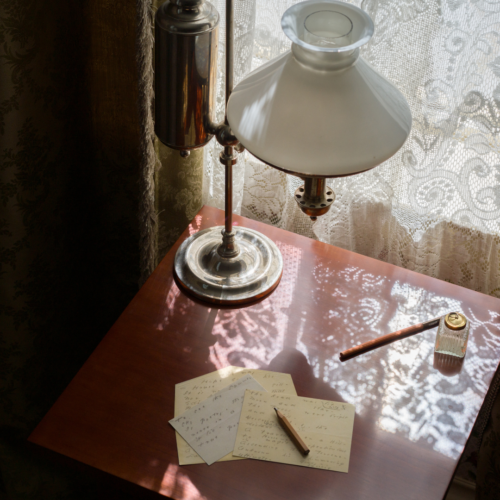
 

Dickinson's writing desk with pens, scraps of paper and her lamp

Mild Nights!
At the Emily Dickinson Museum

Dickinson's writing desk with pens, scraps of paper and her lampIN-PERSON PROGRAM

‘Mild Nights!’ at the Emily Dickinson Museum

Spend an evening in Emily Dickinson’s home, in quiet community with fellow creatives! For Dickinson, everyday life was a wellspring of poetic imagination, and evidence suggests she put pen to paper whenever and wherever that inspiration struck. Reserve a desk in one of the Homestead’s restored 19th-century spaces where the poet spent her own ‘Wild Nights!’.

On this decidedly mild night, participants can write letters, compose poetry or prose, draw, read, or contemplate for two uninterrupted hours. A tour guide welcomes the group with a brief orientation to the house, and each participant is provided with a chair and a small writing table with a desk light in their designated space. 

Looking for a more private experience? Check out our Studio Sessions program.

2026 Sessions:

  • Tuesday, January 20, 5 – 7pm
  • Tuesday, February 10, 5 – 7pm
  • Tuesday, March 10, 5 – 7pm
  • Tuesday, April 28, 5 – 7pm
  • Tuesday, May 12, 5 – 7pm

Pricing: $75 per person

RESERVE YOUR SEAT

“The event itself was a complete joy. Sitting in the library of the Dickinson home and writing for two hours was a dream. I felt as though I had traveled back in time. The quiet atmosphere added to the experience. So much of life is loud, but that night was quiet.” — Beth Ann J.


Rooms


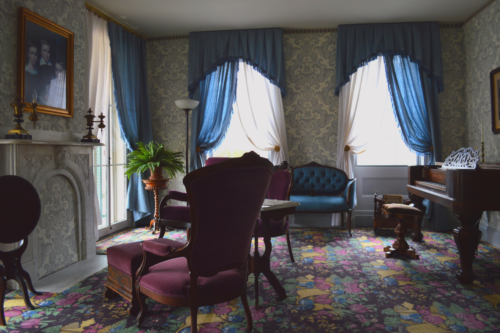
The parlor of the Homestead

The Parlors (4 seats): A double room on the first floor with spaces for family time and entertaining. Find yourself seated near the portrait of the Dickinson children, an original Italianate marble fireplace mantel, or an 1852 square piano amid plush fabrics and cool tones once enjoyed by Amherst’s elite. 


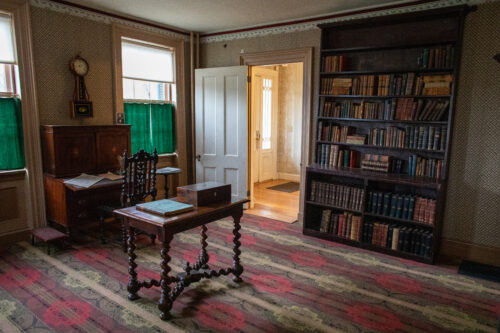
The library of the Homestead

The Library (2 seats): A cozy room on the first floor where Emily Dickinson accessed the literary world through the family’s vast collection of verse and prose, news subscriptions, and academic texts. The poet’s conservatory opens into this room.


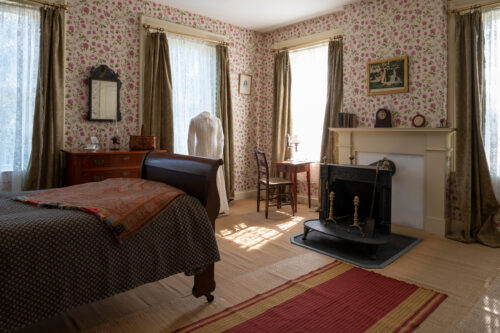
Dickinson's bedroom with the bed, desk and white dress

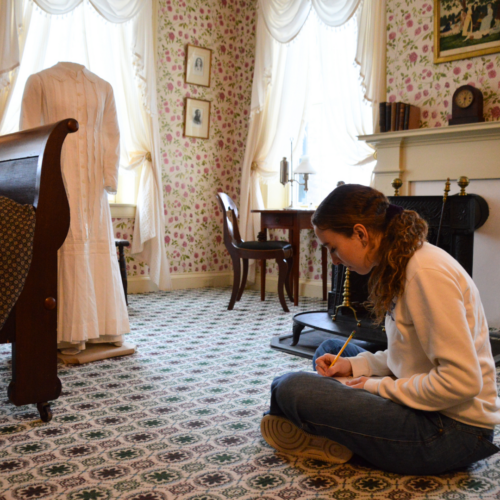
Emily Dickinson’s Bedroom (2 seats): The southwest room on the second floor where the poet spent her most private writing time. Find yourself surrounded by the rose-patterned wallpaper and personal effects, including her sleigh bed.


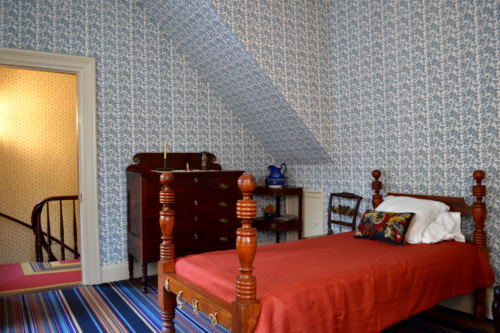
The northwest chamber of the Homestead

Northwest Bedchamber (1 seat): This second floor bedroom was a refuge for Emily Dickinson’s mother in her final years. The poet spent significant time caring for her mother in this space, which features an original wallpaper pattern and family art and furniture. 


Learn more about these spaces through the Virtual Exploration.
Find out about accessibility at the Museum.

‘Mild Nights!’ are intended to be quiet experiences, but you will likely be sharing a space with other participants. Looking for a solo experience? Check out private Studio Sessions in Emily Dickinson’s bedroom.

Program Guidelines:

  • Registration closes two weeks prior to the event date. Each session requires a minimum of six participants to run. In the case of cancelation, ticket purchasers will be notified two weeks before their session and their ticket will be refunded or rescheduled. 
  • Photo ID must be presented upon arrival for your session and a photocopy will be made which will be destroyed after your session.
  • The door to rooms in use will remain open, and staff will be present nearby at all times. Participants must remain in the designated area of the room and may not touch the historic furnishings.
  • Bags, food, and beverages other than bottled water must be left in the designated area of the tour center.
  • No pens, inks, or paints permitted. Pencil and paper or electronic device only. Other materials must be approved by special request in advance. Outlets may not be available; please arrive with your device fully charged.
  • Participants agree to help maintain a quiet environment for all.
  • Photography for non-commercial, personal use is permitted.
  • Refunding and rescheduling are at the discretion of the Emily Dickinson Museum. Unless a session is canceled by the Museum, ticket refunds or rescheduling are not permitted except in the case of emergency. 


RESERVE YOUR SEAT

Please direct questions to EDMPrograms@emilydickinsonmuseum.org.

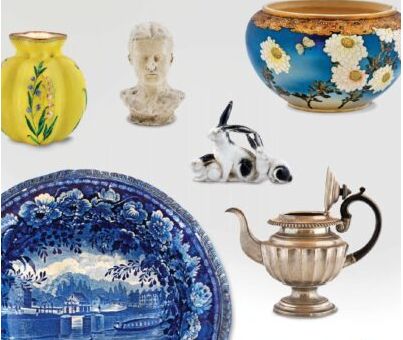
a view of different items in the Emily Dickinson Museum's collections

Press Release:
Collections Database

EMILY DICKINSON MUSEUM ANNOUNCES PUBLIC COLLECTION DATABASE AND IMLS GRANT TO CONTINUE DOCUMENTATION PROJECT

The Museum’s collection had remained largely undocumented and inaccessible, but has now been digitized and published for public use for the very first time.

For Immediate Release
Contact: Patrick Fecher
pfecher@emilydickinsonmuseum.org

a view of different items in the Emily Dickinson Museum's collectionsa view of different items in the Emily Dickinson Museum's collections(Wednesday, September 13, 2023, AMHERST, MA) – Today the Emily Dickinson Museum announces the premiere of its online collection database. The Museum’s collection had remained largely undocumented and inaccessible until a major grant from the Institute of Museum and Library Services in 2019 funded the documentation and baseline cataloging of the entire collection for the very first time. This project has improved collection care, providedpublic access to the collection, will strengthen the museum’s interpretation, and open promising new research opportunities.

The Emily Dickinson Museum’s collection is the largest and most diverse assemblage of objects associated with Emily Dickinson and her family to be found anywhere. It consists of more than 8,000 artifacts, including fine art such as an impressive collection of Hudson River school paintings; cooking, dining, lighting, and heating artifacts; personal items such as Edward Dickinson’s wallet, Susan Huntington Gilbert Dickinson’s sewing kit, children’s toys, handwork, and musical instruments; souvenir objects and art from travels abroad; and a large assortment of clothing and textiles. The collection captures the details of nineteenth-century life in a semi-rural educational and agricultural community and vividly illustrates the daily life and writing habits of one of the world’s greatest poets.

Jane and Robert Keiter Family Executive Director Jane Wald says, “This was, for practical purposes, a hidden collection until a grant from the Institute for Museum and Library Services allowed us to improve our management of these thousands of Dickinson family objects. It’s a significant accomplishment to celebrate in the Museum’s 20th anniversary year.”

Collections Manager Megan Ramsey says, “Documenting our collection is a huge step in taking better care of our artifacts and providing more access to visitors, researchers, and students. With this new digital resource, the museum is able to share more stories about the lives of the Dickinsons.”

The Institute for Museum and Library Services has awarded the Emily Dickinson Museum additional funding to improve documentation about this collection by digitizing institutional records, including photographs, letters and other information related to the artifacts. These records will help to enhance database entries and provide greater context for the collection. The Emily Dickinson Museum will also survey archival material at other institutions, including Amherst College, Jones Library, Mount Holyoke College, Harvard University, Brown University, and Yale University, in order to gather information on the extent of primary sources related to Museum collections objects. Following an intensive three-year IMLS-funded project to create a foundational and comprehensive catalog database, digitizing collections-related information is the logical next step in documenting the collection and understanding the histories of each object. This project will result in more complete collections information management, enabling the Emily Dickinson Museum to interpret the poet’s life and times more fully, and provide public and scholarly access to an important cultural collection.


To access the Collection database, visit: emilydickinsonmuseum.org/museum-collection

For images, please visit: bit.ly/EDM-Images-Collections-Database


ABOUT THE EMILY DICKINSON MUSEUM

The Emily Dickinson Museum is dedicated to sparking the imagination by amplifying Emily Dickinson’s revolutionary poetic voice from the place she called home.

The Museum comprises two historic houses—the Dickinson Homestead and The Evergreens in the center of Amherst, Mass.—that were home to the poet (1830-1886) and members of her immediate family during the nineteenth and early twentieth centuries. The Museum was created in 2003 when the two houses merged under the ownership of the Trustees of Amherst College. The Museum is overseen by a separate Board of Governors and is responsible for raising its own operating, program, and capital funds.

ABOUT THE INSTITUTE OF MUSEUM AND LIBRARY SERVICES 

The Institute of Museum and Library Services is the primary source of federal support for the nation’s libraries and museums. We advance, support, and empower America’s museums, libraries, and related organizations through grantmaking, research, and policy development. IMLS envisions a nation where individuals and communities have access to museums and libraries to learn from and be inspired by the trusted information, ideas, and stories they contain about our diverse natural and cultural heritage. To learn more, visit www.imls.gov

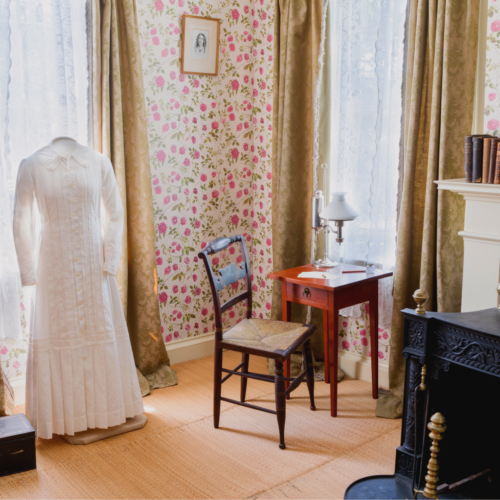
Image of Dickinson's room featuring her writing desk and white dress

Studio Sessions

Image of Dickinson's room featuring her writing desk and white dress

“Sweet hours have perished here;
This is a mighty room;
Within its precincts hopes have played, –
Now shadows in the tomb.”
-Fr1785

Spend a “sweet hour” in Emily Dickinson’s creative space where she penned her startling poetry and honed her revolutionary voice. Whether you are a writer, an artist, a composer, a poet, or a lover of poetry, you’ll find inspiration in Emily Dickinson’s own room. Let this quiet experience jumpstart your next creative journey.

Participants may reserve up to two hours in the room. A small table and chair will be provided.  Participants will experience the atmosphere of Dickinson’s corner chamber, and enjoy the view from her windows.

Program Guidelines:

  • Photo ID must be presented upon arrival for your studio session and a photocopy will be made, which will be destroyed after your session.
  • The door to the room will remain open, and staff will be present nearby at all times. Participants must remain in the designated area of the room and may not touch the historic furnishings.
  • Bags, food, and beverages other than bottled water must be left outside the room.
  • No pens, inks, or paints permitted. Pencil and paper or laptop only. Other materials must be approved by special request in advance.
  • Photography for non-commercial, personal use is permitted.
  • Sessions will not be rescheduled or refunded after booking except in the case of an emergency. Refunding and rescheduling are at the discretion of the Emily Dickinson Museum.

When reserving your session, please navigate to the calendar view to see available days and times.

RESERVE YOUR SESSION

Pricing: (Looking for a more affordable option? Check out our Mild Nights program.)
1 person for 1 hour: $300
1 person for 2 hours: $500
2 people for 1 hour: $400
2 people for 2 hours: $600

Please direct questions to Connect@emilydickinsonmuseum.org.

For studio sessions that occur during the Museum’s public tour season (March – December): Your purchase grants one free Museum admission per studio participant, to be booked during your visit to Amherst. To reserve your timed entry in advance, e-mail connect@emilydickinsonmuseum.org.

Education school group in the Evergreens

K-12 Group Visits

a student writing while sitting on the floor in Dickinson's bedroom

Spark your students’ imaginations by visiting the Emily Dickinson Museum.

Plan a field trip to the place she called home in Amherst, MA by signing up for The Power of Poetry tour or This was a Poet tour — learn more below!

If you’d like to work with the Emily Dickinson Museum, but don’t see an opportunity that would fit the age or needs of your students, please reach out to us at edmprograms@emilydickinsonmuseum.org. We’d love to connect with you!


Click to learn more:

Discover the ways that Dickinson embraced her unique personal vision, defying societal and literary convention to pen nearly 1800 revolutionary poems. In this participatory program, led by experienced educators, students will:

  • Tour the Homestead to learn about the poet’s early life, inspirations, and how she forged her own definition of poetry
  • Explore Dickinson’s writing process through a hands-on investigation of facsimile poem manuscripts
  • Write an original poem, reflecting on their own lives with a Dickinson-inspired prompt

Booking Information:

  • 90-minute program; anticipate up to 2 hrs on site.
  • Maximum group size: 36 (including adults). Groups larger than 12 will be divided and tour simultaneously.
  • Please book two weeks in advance. Following your request, the Museum will reach out to you to confirm the details of your visit and issue an invoice for a 50% deposit to secure your reservation.

Pricing:

  • $10 per student, one free adult per every 12 students.
  • $15 additional teachers, $17 additional adult chaperones.
  • Groups of fewer than 10 will be charged a fee to meet a $120 minimum. 
  • Amherst-Pelham public schools are free of charge.

RESERVE THE POWER OF POETRY

Thanks to a generous donation, we are offering a limited number of Massachusetts public schools reimbursements of up to $650 for transportation and admission fees, excluding $100 deposit. Scholarships will be awarded on a first-come-first-served basis — claim your scholarship by reserving your group visit today!

Apply for a Power of Poetry scholarship

Power of Poetry Supports Massachusetts Grades 6-12 Anchor Standards for Reading; Writing; Speaking and Listening; and Language

READING
Key Ideas and Details
1. Read closely to determine what a text states explicitly and to make logical inferences from it; cite specific textual evidence when writing or speaking to support conclusions drawn from a text. 

Craft and Structure
4.  Interpret words and phrases as they are used in a text, including determining technical, connotative, and figurative meanings, and analyze how specific word choices shape meaning or tone.

5. Analyze the structure of texts, including how specific sentences, paragraphs, and larger portions of a text relate to each other and the whole. 

6. Assess how point of view or purpose shapes the content and style of a text.

Integration of Knowledge and Ideas
7. Integrate and evaluate content presented in diverse formats and media, including visually and quantitatively, as well as in words.13

WRITING
Text Types and Sequences
3.  Write narratives to develop experiences or events using effective literary techniques, well-chosen details, and well-structured sequences.

Range of Writing
10. Write routinely over extended time frames (time for research, reflection, and revision) and shorter time frames (a single sitting or a day or two) for a range of tasks, purposes, and audiences.

SPEAKING AND LISTENING
Comprehension and Collaboration
1. Prepare for and participate effectively in a range of conversations and collaborations with diverse partners, building on others’ ideas and expressing their own clearly and persuasively.
2. Integrate and evaluate information presented in diverse media and formats, including visually, quantitatively, and orally.

LANGUAGE
Vocabulary Acquisition and Use
5. Demonstrate understanding of figurative language, word relationships, and nuances in word meanings.

The Museum’s general audience tours are led by knowledgeable guides who introduce Dickinson’s journey as a poet, with an emphasis on sharing her poems and letters.

Booking Information:

  • Available Thursday mornings.
  • 50-minute tour of the Homestead only.
  • Appropriate for middle and high school students.
  • Please book two weeks in advance. Following your request, the Museum will reach out to you to confirm the details of your visit and issue an invoice for a 50% deposit to secure your reservation.

Pricing:

  • $10 per student, one free adult per every 12 students.
  • $15 additional teachers, $17 additional adult chaperones.
  • Groups of fewer than 10 will be charged a fee to meet a $120 minimum.
  • Amherst-Pelham public schools are free of charge.

RESERVE THIS WAS A POET


Partnership Programs for K-12

If you’d like to work with the Emily Dickinson Museum, but don’t see an opportunity that would fit the age or needs of your students, please reach out to us at edmprograms@emilydickinsonmuseum.org. We’d love to connect with you! We can discuss:

  • How to tailor content or teaching methods to support your group
  • Experiential learning activities you’d like to develop or offer in collaboration with the Museum

Press Release:
Carriage House Opening

For Immediate Release
Contact:
Patrick Fecher
publicrelations@emilydickinsonmuseum.org

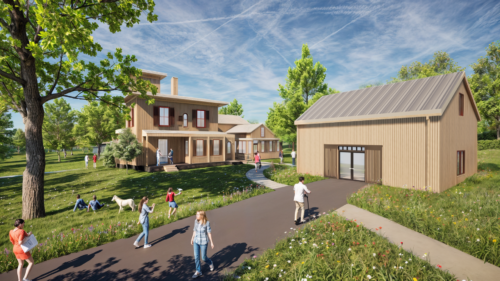
Digital rendering of completed Evergreens Carriage

Digital rendering of completed Evergreens Carriage House (edmsSTUDIO)

EMILY DICKINSON MUSEUM OPENS NEWLY RECONSTRUCTED CARRIAGE HOUSE THAT ONCE STOOD ON THE HISTORIC PROPERTY

On Saturday, May 10, the Emily Dickinson Museum will celebrate the opening of the John and Elizabeth Armstrong Carriage House and the reopening of The Evergreens during its annual Poetry Walk event.

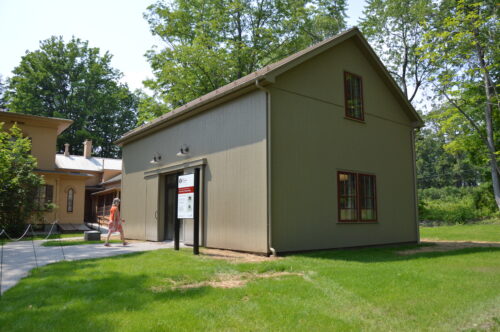
(AMHERST, Mass., April 3, 2025) – The Emily Dickinson Museum has completed the reconstruction of the carriage house that once stood to the east of The Evergreens, the home of Emily Dickinson’s brother Austin and his wife Susan. The carriage house will initially serve as a site for visitor welcome, orientation and museum shop, while also enabling the third and final phase of the Dickinson Homestead restoration.

The exterior appearance of the carriage house is as faithful as possible in its design to evidence accumulated from historic maps, lithographs, and photographs. The interior layout mimics that of the historic carriage house while optimizing modern functions and flow. At the outset of the design phase, museum staff worked with architects at edmSTUDIO to track down details of the original structure in historic maps, deeds, insurance documents, photographs, and archaeological reports. During the course of construction, museum staff discovered that the carriage house was most likely constructed at the same time as the Italianate portion of The Evergreens dwelling, built in 1856, rather than earlier as originally thought. In a photograph taken in about 1870, the carriage house appears as a prominent yet simple vernacular structure with window and door openings barely visible. Insurance maps from the late nineteenth and early twentieth centuries revealed that it was a wood frame structure with two levels and a metal roof. Wandering journalist Christopher Morley documented the structure in his 1936 travel memoir Streamlines. Details such as these gave the design team guidance about the exterior appearance and finishes.

Along with reconstructing the historical appearance of the carriage house, the Museum prioritized sustainability with the goal of achieving passive house certification from the Passive House Institute US. Architects Monica Del Rio Perez and Tim Widman of edmSTUDIOS collaborated on a design using construction techniques and materials that will result in significant energy savings and eliminate reliance on fossil fuels for heating and cooling. The Museum engaged Teagno Construction, Inc., who recently worked on the second phase of Homestead restoration, as general contractor for the project.

The carriage house reconstruction project was supported by a major pledge from former Board members and long-time friends John and Elizabeth Armstrong. “We’ve always been proud of our association with the Museum, recognizing its importance to our regional community and now–through the wonders of technology–to the world.” stated Elizabeth, adding, “We’ve been drawn over the years to supporting singular projects that open multiple possibilities for the Museum. The carriage house is just such a project.”

Jane and Robert Keiter Family Executive Director Jane Wald says, “Opening the carriage house is a significant milestone in long-range goals for the Emily Dickinson Museum established more than twenty years ago. Much has happened between then and now thanks to the many supporters who have shared the Museum’s vision–and especially thanks to John and Elizabeth Armstrong who have been steadfast friends of the Museum since its establishment.  By moving some functions into the  carriage house, the Museum can more quickly complete the last phase of restoring Emily Dickinson’s Homestead so that her daily life and literary legacy can be more fully presented and appreciated in the place it was created. Moreover, we couldn’t be more pleased that this commitment to passive house construction and environmental responsibility reflects Dickinson’s regard for the natural world and the inspiration she drew from it.” 

Erin Martin, Senior Director of Development says, “We are deeply grateful to the Armstrongs for their extraordinary generosity and leadership – which moved this project from the pages of our long-range plan and made it a reality. The carriage house is a testament to the Armstrong’s’ long partnership with the Emily Dickinson Museum and is their gift to the wide community of people both here and around the world who love the poet, and this place. 

Closed since August due to carriage house construction, The Evergreens will reopen to the public on May 1st. The Emily Dickinson Museum used the period of closure as an opportunity to stabilize and conserve the first floor hallway wallpaper. This work was completed by Works on Paper, LLC. As of May 1st, tickets to the Emily Dickinson Museum will include tours of both the Homestead and The Evergreens.

On May 10, in honor of the 139th anniversary of the poet’s death, the Emily Dickinson Museum will host their annual Poetry Walk through downtown Amherst, the town Dickinson called “paradise.” This year’s Walk celebrates the opening of the newly reconstructed carriage house and the reopening of The Evergreens with stops that explore its significance to Amherst’s cultural landscape and to the poet herself. This is a free public program. 

ABOUT THE PROJECT
The design calls for reconstructing the exterior historic appearance of the carriage house as faithfully as possible while optimizing interior functions and flow. At the outset of the design phase, museum staff worked with architects at edmSTUDIO to track down details of the original structure in historic maps, deeds, insurance documents, photographs, and archaeological reports. The original structure may have been built as early as the 1840s as an outbuilding associated with the modest cottage owned by the poet’s father, which was incorporated into The Evergreens dwelling, built for Austin and Susan Dickinson in 1856. In a photograph taken in about 1870, the carriage house appears as a prominent yet simple vernacular structure with window and door openings barely visible. Insurance maps from the late nineteenth and early twentieth centuries revealed that it was a wood frame structure with two levels and a metal roof. Details such as these gave the design team guidance about the exterior appearance and finishes.

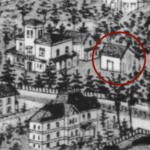
Archival photograph of The Evergreens and Carriage House (in middle ground of photo)

Archival photograph of The Evergreens and Carriage House (in middle ground of photo)

As new construction, the carriage house gives the Emily Dickinson Museum an opportunity to combine its sustainability and historical priorities. Since 2006, the museum has recognized that full interpretation of the historic Dickinson site and the poet’s life cannot be completely understood from a functional and aesthetic perspective without reconstruction of the outbuildings. While the current project is being carried out as a “historic reconstruction,” it also gives the museum the opportunity to advance its sustainability goals. Working with Monica Del Rio Perez and Tim Widman of edmSTUDIO, the design calls for construction techniques and materials selections that will produce significant energy savings and carbon reduction for heating and cooling. The museum has engaged Teagno Construction, Inc., as general contractor for the project.

Jane and Robert Keiter Family Executive Director Jane Wald says, “Reconstruction of the Evergreens carriage house is a true milestone for the Emily Dickinson Museum. It’s the linchpin of our future plans to complete the Homestead restoration – an effort that’s already transformed our sense of who Emily Dickinson was and how she lived. Not only does the carriage house begin to fill out the Dickinson landscape, but its flexible interior also offers greater comfort, better service, and much-needed space for public and educational programming that’s already on the drawing board.”

For press-approved images: https://bit.ly/Press-Carriage-House

To learn more about Poetry Walk: EmilyDickinsonMuseum.org/poetry-walk-2025

ABOUT THE EMILY DICKINSON MUSEUM

The Emily Dickinson Museum is dedicated to sparking the imagination by amplifying Emily Dickinson’s revolutionary poetic voice from the place she called home.

The Museum comprises two historic houses—the Dickinson Homestead and The Evergreens in the center of Amherst, Mass.—that were home to the poet (1830-1886) and members of her immediate family during the nineteenth and early twentieth centuries. The Museum was created in 2003 when the two houses merged under the ownership of the Trustees of Amherst College. The Museum is overseen by a separate Board of Governors and is responsible for raising its own operating, program, and capital funds.


A Something Overtakes the Mind graphic

A Something Overtakes the Mind

IN-PERSON ART AND POETRY INSTALLATION
Did you ever read one of her Poems backward, because the plunge from the front overturned you? I sometimes (often have, many times) have – A something overtakes the Mind –

A Something Overtakes the Mind graphic

The installation is free to the public during the Museum’s open hours and will be on view beginning August 1, 2025 through December 21, 2025.

“Did you ever read one of her Poems backward,” Emily Dickinson wrote on a scrap of wrapping paper, “because the plunge from the front overturned you? I sometimes (often have, many times) have—A something overtakes the Mind.” Although we’ll never know which poet Dickinson was referencing here, it’s clear that she felt the need to alter her approach to the poems at hand as a means of entering the work. A Something Overtakes the Mind—a multimedia visual art and poetry installation created by Ligia Bouton and Matt Donovan for the Emily Dickinson Museum—takes a cue from these words from Emily Dickinson and, through explorations of domestic objects, biographical details, found poetry, and community testimonials, seeks to find new ways of engaging with the poet’s life and legacy. 

On August 1st, the Emily Dickinson Museum will open an art installation featuring the work of visual artist Ligia Bouton and poet Matt Donovan. The installation will be on view on the ground floor of the Homestead in spaces that historically served the Dickinson family as their laundry room, kitchen, and dining room. In 2026, the Museum will prepare this part of the historic house for the third and final phase of Homestead restoration. 

In addition to other objects from the Museum collection, the installation is anchored by two significant sets of Dickinson family objects: wallpaper fragments from the poet’s bedroom and pieces of unassembled quilts. Visitors will encounter laser-cut forms echoing the delicate contours of the wallpaper scraps, filled with curated texts spanning centuries, including biographical insights and interpretations of Dickinson’s signature “em” dash, poetically mirrored in the wallpaper’s design.

In the kitchen space, quilt fragments will be paired with shadowboxes and vitrines containing domestic objects from the Museum’s collection.  Paper scraps remaining on the quilt pieces showcase legible text, forming the basis for artistic language collages and found-word poetry.

A final feature will invite audience interaction through a hands-on poetry-making station using words from the papers enclosed in quilt fragments, alongside a video installation featuring community members reading Dickinson’s poetry and reflecting on her enduring legacy.


ABOUT THE ARTISTS

Ligia Bouton headshotLigia Bouton was born in Sao Paulo, Brazil, and currently divides her time between Massachusetts and New Mexico in the US.  Her creative work combines sculpture and photography with performance and digital video to recreate appropriated narratives and research drawn from the history of science, literature, and other sources.  Bouton’s recent projects have been shown at museums such as the Copenhagen Contemporary (Denmark), Crystal Bridges Museum of American Art, the National Museum of Women in the Arts, Guildhall Art Gallery (London, UK), Minneapolis Institute of Art, SITE Santa Fe, the New Mexico Museum of Art, the Philadelphia Art Alliance, Bellevue Arts Museum, the Minneapolis Institute of Art, and the Boulder Museum of Contemporary Art.  In 2016, Bouton’s work was featured in the exhibition, “Charlotte Great and Small,” celebrating the bicentenary of Charlotte Brontë’s birth at the Brontë Parsonage Museum in Yorkshire, England.  Bouton’s video work has been shown at Art Claims Impulse in Berlin, in the Biennial of Contemporary Art, Nimes, France, and at the Temporary Art Center, Eindhoven, The Netherlands, as well as in The Female Avant Garde Festival in Prague.  Reviews of this work have appeared in Art in America, Art Papers, The Art Newspaper, Art Ltd., and The New York Times.  She is the recipient of a 2016 Creative Capital grant for the opera “Inheritance” which premiered at University of California, San Diego in 2018 and a 2020 Smithsonian Artist Research Fellowship for her project “25 Stars: A Temporary Monument for Henrietta Swan Leavitt”.  Her work can be found in numerous public and private collections including Crystal Bridges Museum, the Albuquerque Museum, St. John’s College, and the Falconer Gallery at Grinnell College. Bouton is currently Professor of Art Studio at Mount Holyoke College in South Hadley, Massachusetts.

Matt Donovan headshotMatt Donovan is the author of four books and two chapbooks: We Are Not Where We Are (an erasure of Walden, co-authored with Jenny George, Bull City Press 2025), The Dug-Up Gun Museum (a collection of poems about guns and gun violence in America, BOA 2022), Missing Department (a collaborative collection of art and poetry created with artist Ligia Bouton, Visual Studies Workshop 2023), A Cloud of Unusual Size and Shape: Meditations on Ruin and Redemption (a book of lyric essays, Trinity University Press 2016), Rapture & the Big Bam (selected by Lia Purpura for the Snowbound Chapbook Competition, Tupelo Press 2016), and Vellum (selected by Mark Doty for the Bakeless Contest, Houghton Mifflin 2007). Donovan is the recipient of a Whiting Award, a Rome Prize in Literature, a Pushcart Prize, a Levis Reading Prize, and an NEA Fellowship in Literature. His work has appeared in numerous journals, including AGNI, American Poetry Review, The Believer, Kenyon Review, The New England Review, Poetry, Threepenny Review, and Virginia Quarterly Review. Donovan serves as Director of the Boutelle-Day Poetry Center at Smith College.


ABOUT FAIR AND SOFTLY

“Fair and Softly” is a small band that particularly explores music for English Dance, a social dance that was popular in Emily Dickinson’s lifetime. Indeed there are some dances in her personal music book. We imagine that playing this old music while celebrating a new installation for the Homestead is a fitting background to the exploration of 19th century poetry. We hope that our period instruments invoke the sounds and sensibilities of the age.

Aaron Hayden is an engineer at Amherst College and has been involved in early music since elementary school; he currently plays and sings in several early music ensembles in the Pioneer Valley.

Madeline Zanetti is a graduate of New England Conservatory with a degree in Music Performance who has been active for many years in early music performance in Colorado and New England.

Sue Matsui is a school music teacher and church musician who has been in love with early music since childhood, and plays a variety of medieval instruments.

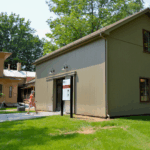
a woman walks into the newly reconstructed carriage house

Press Release:
Carriage House Earns Passive House Certification

For Immediate Release
Contact:
Patrick Fecher
publicrelations@emilydickinsonmuseum.org

A woman walks into the recently completed carriage house on a sunny day

EMILY DICKINSON MUSEUM EARNS PHIUS CERTIFICATION FOR RECENTLY CONSTRUCTED CARRIAGE HOUSE BUILDING

In collaboration with edmSTUDIO and Teagno Construction, inc., the Emily Dickinson Museum carriage house reconstruction has earned passive house certification. It is the first passive house historic reconstruction in the U.S.

(AMHERST, Mass., October, 9, 2025) – The Emily Dickinson Museum, edmSTUDIO, and Teagno Construction, Inc. have achieved passive house certification from PHIUS (Passive House Institute US) for the recently reconstructed carriage house building. The carriage house once stood to the east of The Evergreens, the home of Emily Dickinson’s brother Austin and his wife Susan. The exterior appearance of the carriage house is as faithful as possible in its design to evidence accumulated from historic maps, lithographs, and photographs. The interior layout mimics that of the historic carriage house while optimizing modern functions and flow.

At the outset of the design phase, museum staff worked with architects at edmSTUDIO to track down details of the original structure in historic maps, deeds, insurance documents, photographs, and archaeological reports. During the course of construction, museum staff discovered that the carriage house was most likely constructed at the same time as the Italianate portion of The Evergreens dwelling, built in 1856, rather than earlier as originally thought. In a photograph taken in about 1870, the carriage house appears as a prominent yet simple vernacular structure with window and door openings barely visible. Insurance maps from the late nineteenth and early twentieth centuries revealed that it was a wood frame structure with two levels and a metal roof. Wandering journalist Christopher Morley documented the structure in his 1936 travel memoir Streamlines. Details such as these gave the design team guidance about the exterior appearance and finishes. 

Phius Certified Projects have had their designs and energy models approved by the Phius

Certification Staff, and have been inspected on-site by certified third-party quality assurance professionals trained by Phius to work on Phius projects. The rigorous Phius certification process ensures the building is designed and built to perform up to the targets determined by the climate-specific, cost-optimized Phius Standard.

“Achieving Phius Certification for a project is an accomplishment worth celebrating as it is representative of the hard work of the project team and shows that this project will be among the most efficient and comfortable buildings in the world,” James Ortega, Phius Project Certification Manager.

Architects Monica Del Rio Perez and Tim Widman of edmSTUDIO collaborated on a design using construction techniques and materials that will result in significant energy savings and eliminate reliance on fossil fuels for heating and cooling. The Museum engaged Teagno Construction, Inc., who recently worked on the second phase of Homestead restoration, as general contractor for the project.

“The recreation of the Emily Dickinson Carriage House re-establishes the historic fabric of the site, enabling a more complete interpretation of the poet’s life and surroundings for the Museum. The project was an opportunity to create a dialogue between the past and the future via historical reference and developing building science focused on sustainability. As a hub for visitor engagement, the reconstructed Carriage House invites guests to draw inspiration from its lived literary legacy, architectural presence, and renewed purpose to educate in both fields,” Tim Widman, Principal at edmSTUDIOS.

“Having worked through a number of historic restoration projects for the Emily Dickinson Museum, it was an exciting new challenge to take on a Passive Build at this incredible property. We rarely get to work on projects that have such significance both historically, and from an energy efficiency perspective. Being included in this process has been an absolute honor, and we would like to say thank you to Jane Wald and her wonderful staff, the design team, our Phius consultants, subcontractors, and Amherst College. It truly was a fun project,” David Tynan, General Manager of Teagno Construction, Inc.

The carriage house reconstruction project was supported by a major pledge from former Board members and long-time friends John and Elizabeth Armstrong. “We’ve always been proud of our association with the Museum, recognizing its importance to our regional community and now–through the wonders of technology–to the world.” stated Elizabeth, adding, “We’ve been drawn over the years to supporting singular projects that open multiple possibilities for the Museum. The carriage house is just such a project.”

Jane and Robert Keiter Family Executive Director Jane Wald says, “Opening the carriage house is a significant milestone in long-range goals for the Emily Dickinson Museum established more than twenty years ago. Much has happened between then and now thanks to the many supporters who have shared the Museum’s vision–and especially thanks to John and Elizabeth Armstrong who have been steadfast friends of the Museum since its establishment. By moving some functions into the carriage house, the Museum can more quickly complete the last phase of restoring Emily Dickinson’s Homestead so that her daily life and literary legacy can be more fully presented and appreciated in the place it was created. Moreover, we couldn’t be more pleased that this commitment to passive house construction and environmental responsibility reflects Dickinson’s regard for the natural world and the inspiration she drew from it.” 

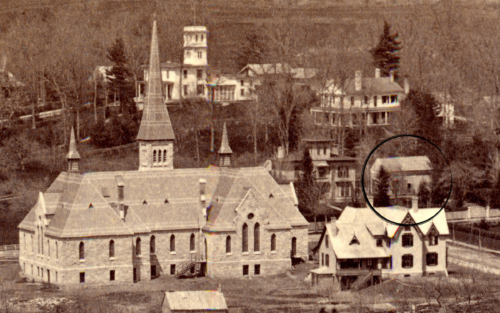
Archival photograph of The Evergreens and Carriage House (in middle ground of photo)

Archival photograph of The Evergreens and Carriage House (in middle ground of photo

For press-approved images: https://bit.ly/Press-Carriage-House

ABOUT THE EMILY DICKINSON MUSEUM

The Emily Dickinson Museum is dedicated to sparking the imagination by amplifying Emily Dickinson’s revolutionary poetic voice from the place she called home.

The Museum comprises two historic houses—the Dickinson Homestead and The Evergreens in the center of Amherst, Mass.—that were home to the poet (1830-1886) and members of her immediate family during the nineteenth and early twentieth centuries. The Museum was created in 2003 when the two houses merged under the ownership of the Trustees of Amherst College. The Museum is overseen by a separate Board of Governors and is responsible for raising its own operating, program, and capital funds.

ABOUT PHIUS

Phius is a 501(c)(3) nonprofit organization dedicated to supporting comfortable living for all and the well-being of the planet. This means driving down carbon emissions and working toward a net zero future. Phius works toward this goal by training and certifying professionals, maintaining the Phius climate-specific passive building standard, certifying and quality assuring passive buildings, certifying high performance building products and conducting research to advance high-performance building.

a model dressed as Dickinson with her back to the camera sitting at her writing desk

‘Revolution is the Pod’:
Emily Dickinson’s American Poetry

NEH Summer Institute for Teachers
July 19-24 or 26-31, 2026

Application deadline: March 6, 2026, 11:59pm ET

Designed for K-12 educators, this workshop will examine Dickinson’s poetry in light of the rhetoric of her day, as Americans grappled with a national identity one century on from the American Revolution. Through creative writing and engagement with contemporary poets, participants will also explore how Dickinson’s rule-breaking, revolutionary poetry sparks the imaginations of new generations.

Emily Dickinson Museum’s National Endowment for the Humanities Summer Institute for Teachers
‘Revolution is the Pod’: Emily Dickinson’s American Poetry

Session I:
July 8 6:30-8:30PM ET live virtual session
July 19-24, 2026,  in-person in Amherst, MA

Session II:
July 15 6:30-8:30PM ET live virtual session,
July 26-31, 2026, in-person in Amherst, MA

Application deadline, March 6, 2026


Learn more about the workshop:

Through this immersive exploration of Dickinson’s Amherst, small group coaching, and workshops led by world-class Dickinson scholars and contemporary poets, participants will:

  • Gain skills in reading manuscripts and teaching with objects;
  • Strengthen approaches to poetry and creative writing with students;
  • Explore Emily Dickinson’s revolutionary poetry and consider its use in empowering students as both writers and thinkers.

In the poem “Revolution is the Pod,” Dickinson argues that “Revolution” is a flower that must be seasonally tended (in fact, pruned) to remain vital. The theme of revolution is especially pertinent to Dickinson not only because her experimental verse defied the poetic conventions of her time, but also because she lived during a historical moment defined by many consequential revolutions that shaped American history and identity. These include the American Revolution, just 44 years prior to her birth and already mythologized in New England; the Second Great Awakening and its sweep of religious revivals; ongoing industrial and scientific revolutions; and most significantly, the American Civil War. Because our own age is similarly marked by rapid technological change and deep political divide, Dickinson’s poems carry a special resonance.

The Summer Institute in the poet’s home of Amherst, Massachusetts, allows participants to spend an immersive week in Dickinson’s environment, enriching their understanding of her poetry and its broader context in nineteenth-century New England. Students will have access to the Homestead (1813), the poet’s birthplace and home for forty years; The Evergreens (1856), the home of her family next door and an integral part of her intimate world; as well as special collections of manuscripts and related material culture held by Amherst College’s Frost Library and Jones Library.

The workshop brings together faculty who have written or edited significant works about Dickinson in the past five years, including a new biography, a complete edition of her letters, and an Oxford Handbook. The proposed program highlights new scholarship on place (connecting Dickinson’s Amherst to the Nonotuck Homeland), the influence of Dickinson’s letters and networks on her poetry, her nineteenth-century media contexts, and her engagement with the political and scientific debates of her day. With her life and verse as a lens, the workshop also explores the changing landscape and demographics of New England; the rapid professionalization of science and impact of fossil discoveries; the intellectual connections between Dickinson and figures like Ralph Waldo Emerson and poet/potter David Drake; and Dickinson’s impact on contemporary poetry and culture.

In addition to plenary talks and workshops, participants will be divided into three learning cohorts, which meet periodically across the week. Supported by cohort leaders with strong backgrounds in teaching and Dickinson, these small groups allow participants to engage in the lively discourse with peers that energizes and inspires good teaching. During curriculum group meetings, participants will complete a template that outlines an outcome-based learning project useful for their unique teaching circumstances. This “curriculum artifact” might include a unit; professional development program for colleagues; service learning project; or curation of an electronic resource or collection (text set, primary source collection, slide deck). At the final learning cohort session on Friday, participants will use a feedback protocol endorsed by The National Writing Project that prompts shared learning and encourages further conversations between teachers after the workshop has ended.

Program Schedule & Resource List

Stipend
Stipends are intended to compensate participants for their time commitment and to help defray the costs of participation, which may include expenses such as travel, lodging, and meals. Stipends are taxable income and amounts are determined by NEH based on the duration and format of the program. For 2026 ‘Revolution is the Pod’, participants who complete the one-week workshop receive $1300.

Lodging
Participants have the option to commute, reserve a hotel room for the week, or stay in Seelye Hall dormitory on the Amherst College campus from Sunday to Friday. Located in the center of downtown Amherst, Seelye is a 10-minute walk along paved sidewalks from Keefe Campus Center, where the workshop will be based, and a 10-minute walk along paved sidewalks to the Emily Dickinson Museum. Amenities in the dormitory include: First-floor laundry units, shared lounge spaces, and wifi. The dorm is first-floor accessible for wheelchair users. Please note that the dormitory is not air-conditioned. Individual air conditioning units may be installed for a fee by medical accommodation only. Bedrooms in the dorm include single and double occupancy. Bathrooms are shared. The cost of lodging per night is $42 for participants who choose to stay in the dormitory. Although the workshop ends midday on Friday, participants may arrange to stay on campus until Saturday morning for an additional fee.

Participants who prefer to reserve a hotel room will find many options within a short driving distance to the workshop location. Rates begin at $150/night, and access to a personal vehicle is recommended to commute to campus.

Meals
Participants will have the option of purchasing a daily meal plan that includes breakfast and lunch from Amherst College campus dining services. With the exception of Sunday night of the workshop week, dinner is not provided. Downtown Amherst has a wealth of dining options within walking distance from the workshop location, and delivery is also an option.

Travel
Amherst, Massachusetts is roughly a two-hour drive from Boston, three-hour drive from New York City, and Bradley International Airport is a one-hour drive. Ride-shares, such as Uber and Lyft, are available, as are private and shared ground transportation services through Valley Transporter. Amtrak stops in the nearby town of Northampton, Massachusetts, a 20-minute drive from Amherst.

Project Co-Directors:

Elias Bradley is Education Programs Manager at the Emily Dickinson Museum. Bradley has led the growth of school programming, academic partnerships, and educator professional development for 8 years. Prior to working at the Emily Dickinson Museum, Elias was Senior Educator at the public garden and Cultural Center Wave Hill, leading interdisciplinary school programs connecting history, art, and the living environment. Elias has a BA in English and History from the University of Illinois, and MA in Public History from the University of Massachusetts Amherst. 

Brooke Steinhauser is Senior Director of Programs at the Emily Dickinson Museum where she oversees interpretation, education, visitor experience, and public programming. She was a workshop assistant for the Museum’s 2009 Landmarks workshop, and project director for the Museum’s 2017 workshop. She holds a Bachelor’s degree from Muhlenberg College in Art History and a Master’s degree in Museum Studies from the Cooperstown Graduate Program.  


Workshop Faculty:

Martha Ackmann taught in the Gender Studies Department at Mount Holyoke College for thirty years, including a popular seminar on Emily Dickinson in the poet’s house, now the Emily Dickinson Museum. She is a past president of the Emily Dickinson International Society and co-founder of Legacy: A Journal of American Women Writers. Her book, These Fevered Days: Ten Pivotal Moments in the Making of Emily Dickinson (W.W. Norton & Company, 2020), will be one of the assigned pre-reading texts for the Museum’s workshops. She has instructed teachers from across the country through programs including the New England Young Writers Conference and the National Endowment for the Humanities.

Renée Bergland is a literary critic and a historian of science who teaches in the Department of Humanities at Simmons University where she is Program Director of Literature and Writing. Her most recent publication is Natural Magic: Emily Dickinson, Charles Darwin, and the Dawn of Modern Science (Princeton University Press, 2024), which won the British Society for the History of Science’s 2025 Hughes Prize. She contributed an essay, “Dickinson Emergent: Natural Philosophy and the Postdisciplinary Manifold”, to the Oxford Handbook to Emily Dickinson (2022). Bergland is writing a forthcoming general audience book examining Dickinson’s poetry as interpreted through the lens of different sciences, including astronomy, 5 geology, and ecology. She is a member of the board of the Emily Dickinson International Society. 

Lisa Brooks is the Winthrop H. Smith 1916 Professor of American Studies and English at Amherst College. As a writer, literary scholar and historian, she works at the crossroads of early American literature & history, geography and Indigenous studies. Her writing and teaching considers questions about how we see the spaces known as “New England” and “America” when we turn the prism of our perception to divergent angles. Indigenous methodologies, including a focus on language, place, and community engagement, are crucial to her research, as is deep archival investigation. She was a contributor to the Oxford Handbook of Emily Dickinson (Oxford University Press, 2022) with my essay entitled, “Whose Native Place? The Dickinsons and the Colonization of the Connecticut River Valley.” 

Tiana Clark is the Grace Hazard Conkling Writer-in-Residence at Smith College. In addition to scholarships at Bread Loaf, Sewanee Writers’ Conference, the Frost Place Seminar, and Kenyon Review Writers Workshop, she is the winner of the 2020 Kate Tufts Discovery Award. She is a recipient of the 2021–22 Amy Lowell Poetry Traveling Scholarship, a 2019 Pushcart Prize, and is a 2019 National Endowment for the Arts Literature Fellow. As Smith College Writer-in-Residence she is a judge of the Annual Poetry Prize for High School Girls. Her book I Can’t Talk About the Trees Without the Blood won the 2017 Agnes Lynch Starrett Prize, and her 7 first book, Equilibrium (Bull City Press, 2016), was selected by Afaa Michael Weaver for the 2016 Frost Place Chapbook Competition. Clark’s essay “We keep revising our idea of Emily Dickinson. We may never get her right.” was published in the Washington Post in 2019 and she was a headliner of the Emily Dickinson Museum’s Tell It Slant Poetry Festival in 2021. Her latest book of poems, Scorched Earth, is a finalist for the 2025 National Book Award.

P. Gabrielle Foreman  is the Paterno Family Professor of American Literature and Professor of African American Studies and History at Penn State. She is the co-founder and co-director of the Center for Black Digital Research at Penn State and is founding director of the Colored Convention Project. She is known for building collaborative teams that bring the records of seven decades of early Black organizing to digital life.  With artistic director Lynnette Young Overby and poet Glennis Redmond, she has also worked for a decade to bring early Black history to the stage. In 2022, Foreman was awarded the MacArthur Fellowship. 

Cristanne Miller is SUNY Distinguished Professor and Edward H. Butler Professor of Literature at University of Buffalo, emerita, where she publishes on nineteenth- and twentieth-century poetry and culture, including Emily Dickinson: A Poet's Grammar (Harvard University Press, 1987), Reading in Time: Emily Dickinson in the Nineteenth Century (Harvard University Press, 2012), an edition of Dickinson’s complete poems: Emily Dickinson’s Poems: As She Preserved Them (Harvard University Press, 2016), winner of the MLA Scholarly Edition Prize and translated into Portuguese; and The Letters of Emily Dickinson, co-edited with Domhnall Mitchell (Harvard University Press, 2024), named as a best 10 Books of the year by PBS News 3 Hour, NPR, and the London Review of Books. Miller co-edited the 2022 Oxford Handbook of Emily Dickinson with Karen Sánchez-Eppler. She serves on the advisory board of the Emily Dickinson Archive, and formerly on the board of the Emily Dickinson International Society. 

Karen Sánchez-Eppler is L. Stanton Williams 1941 Professor of American Studies and English at Amherst College. The author of Touching Liberty: Abolition, Feminism and the Politics of the Body (1993) and Dependent States: The Child’s Part in Nineteenth-Century American Culture (2005), and co-editor with Cristanne Miller of The Oxford Handbook of Emily Dickinson (2022). She is currently writing a brief critical biography, Emily Dickinson / Critical Lives, for Reaktion Books and working on two other book projects: The Unpublished Republic: Manuscript Cultures of the Mid-Nineteenth Century US and In the Archives of Childhood: Playing with the Past. Her scholarship has been supported by grants from the NEH, ACLS, the Newberry Library, the Winterthur Library, the Stanford Humanities Center, and the Fulbright Foundation. She spent the 2019-20 academic year as Distinguished Scholar in Residence at the American Antiquarian Society, is one of the founding co-editors of The Journal of the History of Childhood and Youth, past President of C19: The Society of Nineteenth-Century Americanists, President of the Porter-Phelps-Huntington Foundation Board of Directors, and a longtime member of the Emily Dickinson Museum’s Board of Governors. 

Jane Wald is the Jane and Robert Keiter Family Executive Director of the Emily Dickinson Museum. Before beginning her tenure at the Dickinson sites in 2001, she worked at Old Sturbridge Village in Sturbridge, Massachusetts. She has been responsible for several major restoration and documentation studies at the Museum and is the author of “‘Pretty much all real life’: The Material World of the Dickinson Family,” in the Blackwell Companion to Emily Dickinson (2008), “The ‘Poet Hunters’: Transforming Emily Dickinson’s Home into a Literary Destination,” in the Emily Dickinson Journal (2018), and “A Short Biography of the Homestead and The Evergreens” in the Oxford Handbook to Emily Dickinson (2022).


Learning Cohort Leaders: 

Bruce Penniman taught writing, speech, and literature at Amherst Regional High School for 36 years, and served as the Site Director of the Western Massachusetts Writing Project at the University of Massachusetts, where he taught numerous graduate courses for teachers. He is the author of Building the English Classroom: Foundations, Support Success (NCTE: 2009). He served as a mentor teacher for the Emily Dickinson Museum’s NEH Landmarks workshops in 2009, 2011, 2013, and 2017, and has led many Emily Dickinson poetry discussion programs for the Museum. 

Wendy Tronrud has a Masters in Teaching from Bard College and a PhD in Literature from CUNY Graduate Center, with a focus in 19th-century American and African American Literature, transhistorical poetry, archival studies, and pedagogy. She has taught at Queens College and Cooper Union, mentored and taught in Bard College’s Master of Teaching program, and been a faculty member for the Bard Prison Institute. She is an active member of the Emily Dickinson International Society and co-chair of the Society’s Pedagogy Committee.


Education Specialist/Learning Cohort Leader:

Deb Polansky has been a Program Supervisor and Field Instructor for Master of Arts in Teaching Students at Brandeis University, as well as a teacher trainer for NAMI (National Alliance on Mental Illness). Prior to her work in teacher education, she was a fourth-grade teacher at Shady Hill School for many years. She serves on the Emily Dickinson Museum Board of Directors and is an active member of the Emily Dickinson International Society.

You are eligible to apply if you are a:  

  • United States citizen, including those teaching abroad at U.S. chartered institutions and schools operated by the federal government;
  • resident of U.S. jurisdictions; or  
  • foreign national who has been residing in the United States or its jurisdictions for at least the three years immediately preceding the application deadline.  

You are not eligible to apply if you:  

  • are a foreign national teaching abroad
  • are related to the project director(s)  
  • are affiliated with the applicant institution (employees, currently enrolled students, etc.)  
  • have been taught or advised in an academic capacity by the project director(s)  
  • are delinquent in the repayment of federal debt (taxes, student loans, child support payments, and delinquent payroll taxes for household or other employees)  
  • have been debarred or suspended by any federal department or agency  
  • have attended a previous NEH professional development project (Seminars, Landmarks, or Institutes) led by the project director(s)  

NEH does not require participants to have earned an advanced degree.  

In any given year, an individual may attend only one Institute or Landmarks workshop.  

J1 and F1 visa holders should confer with their sponsoring institution regarding their eligibility to receive a stipend from another institution. 

To be considered for selection, applicants must submit a complete application as indicated on the individual project’s website. Any questions about applications should be directed to the individual project team at Education@EmilyDickinsonMuseum.org.

Read participant expectations.

Read the NEH Principles of Civility for professional development programs.

NEH's Applicant and Participant FAQs

Workshop-specific FAQs:

Q: Can I receive credit or Professional Development Points for my participation in this summer institute?

A: Participants who complete all Workshop sessions will receive a certificate confirming their participation and contact hours. Participants may use this to apply for Continuing Education Unit credits in their home states.

For further questions, please email the project directors at Education@EmilyDickinsonMuseum.org.

Applications must be submitted through the form found on Survey Monkey Apply. Your submission will provide the selection committee with information about the following:

  • Your teaching background
  • Your interest in this workshop
  • How you would use this information and learning with your students

Application timeline:

  • Applications are due March 6, 2026 
  • You will be notified on April 6, 2026
  • Successful applicants must confirm participation by April 17, 2026

The Museum seeks a geographically diverse group of participants and a range of grades K-12 for both weeks of the Workshop. The selection team especially welcomes participants with a strong interest in interdisciplinary learning.

APPLY


TESTIMONIALS

The Emily Dickinson Museum has offered four previous versions of this workshop through the NEH Landmarks of American History and Culture grant program. The following testimonials come from K-12 educators who participated in the 2017 workshop, “Emily Dickinson: Person, Poetry, Place”.

slide 1
slide 1
slide 1
slide 1
Image Slide 2
Image Slide 2
Image Slide 2
Image Slide 2
previous arrowprevious arrow
next arrownext arrow
Shadow

Contact Us:
If you have read the FAQ page and have further questions, please email the project directors at Education@EmilyDickinsonMuseum.org.

This program has been made possible in part by a major grant from the National Endowment for the Humanities: Democracy demands wisdom. Any views, findings, conclusions, or recommendations expressed in this program, do not necessarily represent those of the National Endowment for the Humanities.
National Endowment for the Humanities logo