
Image of Dickinson's room featuring her writing desk and white dress

Studio Sessions

Image of Dickinson's room featuring her writing desk and white dress

“Sweet hours have perished here;
This is a mighty room;
Within its precincts hopes have played, –
Now shadows in the tomb.”
-Fr1785

Spend a “sweet hour” in Emily Dickinson’s creative space where she penned her startling poetry and honed her revolutionary voice. Whether you are a writer, an artist, a composer, a poet, or a lover of poetry, you’ll find inspiration in Emily Dickinson’s own room. Let this quiet experience jumpstart your next creative journey.

Participants may reserve up to two hours in the room. A small table and chair will be provided.  Participants will experience the atmosphere of Dickinson’s corner chamber, and enjoy the view from her windows.

Program Guidelines:

  • Photo ID must be presented upon arrival for your studio session and a photocopy will be made, which will be destroyed after your session.
  • The door to the room will remain open, and staff will be present nearby at all times. Participants must remain in the designated area of the room and may not touch the historic furnishings.
  • Bags, food, and beverages other than bottled water must be left outside the room.
  • No pens, inks, or paints permitted. Pencil and paper or laptop only. Other materials must be approved by special request in advance.
  • Photography for non-commercial, personal use is permitted.
  • Sessions will not be rescheduled or refunded after booking except in the case of an emergency. Refunding and rescheduling are at the discretion of the Emily Dickinson Museum.

When reserving your session, please navigate to the calendar view to see available days. Sessions are offered on Thursdays and Fridays at 8:30am (1-2 hours) or 4:30pm (1 hour only) during the public tour season.

RESERVE YOUR SESSION: Mornings

RESERVE YOUR SESSION: Evenings

Pricing: (Looking for a more affordable option? Check out our Mild Nights program.)
1 person for 1 hour: $300
1 person for 2 hours: $500
2 people for 1 hour: $400
2 people for 2 hours: $600

Please direct questions to Connect@emilydickinsonmuseum.org.

For studio sessions that occur during the Museum’s public tour season (March – December): Your purchase grants one free Museum admission per studio participant, to be booked during your visit to Amherst. To reserve your timed entry in advance, e-mail connect@emilydickinsonmuseum.org.

a view of different items in the Emily Dickinson Museum's collections

The Emily Dickinson Museum Collection

a view of different items in the Emily Dickinson Museum's collections

The Emily Dickinson Museum's collection is the largest and most diverse assemblage of objects associated with Emily Dickinson and her family to be found anywhere. It consists of more than 8,000 artifacts, including fine art such as an impressive collection of Hudson River school paintings; cooking, dining, lighting, and heating artifacts; personal items such as children’s toys, handwork, and musical instruments; souvenir objects and art from travels abroad; and a large assortment of clothing and textiles. The collection captures the details of nineteenth-century life in a semi-rural educational and agricultural community and vividly illustrates the daily life and writing habits of one of the world’s greatest poets.

The Museum’s collection had remained largely undocumented and inaccessible until a major grant from the Institute of Museum and Library Services in 2019 funded the documentation and baseline cataloging of the entire collection for the very first time. Completed in 2023, this project has improved collection care and, through this database, public access has strengthened the museum’s interpretation, and opened promising new research opportunities.


SEARCH THE COLLECTION (external webpage)

FAQS

What is the history of the collections?
The EDM collection comprises the combined personal effects of Dickinson family members from the Dickinson Homestead (built 1813) and The Evergreens (built 1856), left at the latter house after the death of the family’s last heir in 1988. Dickinson’s niece, Martha Dickinson Bianchi, sold the Homestead in 1916 and moved her aunt’s personal belongings and household furnishings next door to her own home at The Evergreens. Bianchi’s heirs transferred manuscript material, books, and a few dozen objects associated with Emily Dickinson to Harvard University in 1950 and Brown University in 1993. The vast majority of Dickinson family possessions remained at The Evergreens, overseen between 1988 and 2003 by a private testamentary trust established in Bianchi’s name. The Trust transferred the property and  collection to Amherst College in 2003 so that the two neighboring Dickinson family houses and collections could be operated as a united Emily Dickinson Museum.

image-slider-with-thumbnail1.jpeg
PlayPause

Where can I find Dickinson manuscripts or other material?

To view Dickinson's manuscripts, visit www.edickinson.org

For information on other Dickinson repositories:

Houghton Library, Harvard University

Amherst College Special Collections

Brown University Library

Yale University Library

Boston Public Library

Amherst Historical Society

Jones Library

Who can I contact with questions?
Email collections@emilydickinsonmuseum.org with any questions about the collections or online catalog.

How can I access the collections?
Physical access to the collections is very limited at this time. Email Collections@EmilyDickinsonMuseum.org with questions.

Use of these images must be approved by the Emily Dickinson Museum.
Please contact us at: Info@EmilyDickinsonMuseum.org

Institute of Museum and Library Services logo

The Emily Dickinson Museum has received funding for collection documentation from the Institute of Museum and Library Services. IMLS is the primary source of federal support for the nation’s libraries and museums. They advance, support, and empower America’s museums, libraries, and related organizations through grant making, research, and policy development. Their vision is a nation where museums and libraries work together to transform the lives of individuals and communities. To learn more, visit www.imls.gov.

Press Release:
Carriage House Opening

For Immediate Release
Contact:
Patrick Fecher
publicrelations@emilydickinsonmuseum.org

Digital rendering of completed Evergreens Carriage

Digital rendering of completed Evergreens Carriage House (edmsSTUDIO)

EMILY DICKINSON MUSEUM OPENS NEWLY RECONSTRUCTED CARRIAGE HOUSE THAT ONCE STOOD ON THE HISTORIC PROPERTY

On Saturday, May 10, the Emily Dickinson Museum will celebrate the opening of the John and Elizabeth Armstrong Carriage House and the reopening of The Evergreens during its annual Poetry Walk event.

(AMHERST, Mass., April 3, 2025) – The Emily Dickinson Museum has completed the reconstruction of the carriage house that once stood to the east of The Evergreens, the home of Emily Dickinson’s brother Austin and his wife Susan. The carriage house will initially serve as a site for visitor welcome, orientation and museum shop, while also enabling the third and final phase of the Dickinson Homestead restoration.

The exterior appearance of the carriage house is as faithful as possible in its design to evidence accumulated from historic maps, lithographs, and photographs. The interior layout mimics that of the historic carriage house while optimizing modern functions and flow. At the outset of the design phase, museum staff worked with architects at edmSTUDIO to track down details of the original structure in historic maps, deeds, insurance documents, photographs, and archaeological reports. During the course of construction, museum staff discovered that the carriage house was most likely constructed at the same time as the Italianate portion of The Evergreens dwelling, built in 1856, rather than earlier as originally thought. In a photograph taken in about 1870, the carriage house appears as a prominent yet simple vernacular structure with window and door openings barely visible. Insurance maps from the late nineteenth and early twentieth centuries revealed that it was a wood frame structure with two levels and a metal roof. Wandering journalist Christopher Morley documented the structure in his 1936 travel memoir Streamlines. Details such as these gave the design team guidance about the exterior appearance and finishes.

Along with reconstructing the historical appearance of the carriage house, the Museum prioritized sustainability with the goal of achieving passive house certification from the Passive House Institute US. Architects Monica Del Rio Perez and Tim Widman of edmSTUDIOS collaborated on a design using construction techniques and materials that will result in significant energy savings and eliminate reliance on fossil fuels for heating and cooling. The Museum engaged Teagno Construction, Inc., who recently worked on the second phase of Homestead restoration, as general contractor for the project.

The carriage house reconstruction project was supported by a major pledge from former Board members and long-time friends John and Elizabeth Armstrong. “We’ve always been proud of our association with the Museum, recognizing its importance to our regional community and now–through the wonders of technology–to the world.” stated Elizabeth, adding, “We’ve been drawn over the years to supporting singular projects that open multiple possibilities for the Museum. The carriage house is just such a project.”

Jane and Robert Keiter Family Executive Director Jane Wald says, “Opening the carriage house is a significant milestone in long-range goals for the Emily Dickinson Museum established more than twenty years ago. Much has happened between then and now thanks to the many supporters who have shared the Museum’s vision–and especially thanks to John and Elizabeth Armstrong who have been steadfast friends of the Museum since its establishment.  By moving some functions into the  carriage house, the Museum can more quickly complete the last phase of restoring Emily Dickinson’s Homestead so that her daily life and literary legacy can be more fully presented and appreciated in the place it was created. Moreover, we couldn’t be more pleased that this commitment to passive house construction and environmental responsibility reflects Dickinson’s regard for the natural world and the inspiration she drew from it.” 

Erin Martin, Senior Director of Development says, “We are deeply grateful to the Armstrongs for their extraordinary generosity and leadership – which moved this project from the pages of our long-range plan and made it a reality. The carriage house is a testament to the Armstrong’s’ long partnership with the Emily Dickinson Museum and is their gift to the wide community of people both here and around the world who love the poet, and this place. 

Closed since August due to carriage house construction, The Evergreens will reopen to the public on May 1st. The Emily Dickinson Museum used the period of closure as an opportunity to stabilize and conserve the first floor hallway wallpaper. This work was completed by Works on Paper, LLC. As of May 1st, tickets to the Emily Dickinson Museum will include tours of both the Homestead and The Evergreens.

On May 10, in honor of the 139th anniversary of the poet’s death, the Emily Dickinson Museum will host their annual Poetry Walk through downtown Amherst, the town Dickinson called “paradise.” This year’s Walk celebrates the opening of the newly reconstructed carriage house and the reopening of The Evergreens with stops that explore its significance to Amherst’s cultural landscape and to the poet herself. This is a free public program. 

ABOUT THE PROJECT
The design calls for reconstructing the exterior historic appearance of the carriage house as faithfully as possible while optimizing interior functions and flow. At the outset of the design phase, museum staff worked with architects at edmSTUDIO to track down details of the original structure in historic maps, deeds, insurance documents, photographs, and archaeological reports. The original structure may have been built as early as the 1840s as an outbuilding associated with the modest cottage owned by the poet’s father, which was incorporated into The Evergreens dwelling, built for Austin and Susan Dickinson in 1856. In a photograph taken in about 1870, the carriage house appears as a prominent yet simple vernacular structure with window and door openings barely visible. Insurance maps from the late nineteenth and early twentieth centuries revealed that it was a wood frame structure with two levels and a metal roof. Details such as these gave the design team guidance about the exterior appearance and finishes.

Archival photograph of The Evergreens and Carriage House (in middle ground of photo)

Archival photograph of The Evergreens and Carriage House (in middle ground of photo)

As new construction, the carriage house gives the Emily Dickinson Museum an opportunity to combine its sustainability and historical priorities. Since 2006, the museum has recognized that full interpretation of the historic Dickinson site and the poet’s life cannot be completely understood from a functional and aesthetic perspective without reconstruction of the outbuildings. While the current project is being carried out as a “historic reconstruction,” it also gives the museum the opportunity to advance its sustainability goals. Working with Monica Del Rio Perez and Tim Widman of edmSTUDIO, the design calls for construction techniques and materials selections that will produce significant energy savings and carbon reduction for heating and cooling. The museum has engaged Teagno Construction, Inc., as general contractor for the project.

Jane and Robert Keiter Family Executive Director Jane Wald says, “Reconstruction of the Evergreens carriage house is a true milestone for the Emily Dickinson Museum. It’s the linchpin of our future plans to complete the Homestead restoration – an effort that’s already transformed our sense of who Emily Dickinson was and how she lived. Not only does the carriage house begin to fill out the Dickinson landscape, but its flexible interior also offers greater comfort, better service, and much-needed space for public and educational programming that’s already on the drawing board.”

For press-approved images: https://bit.ly/Press-Carriage-House

To learn more about Poetry Walk: EmilyDickinsonMuseum.org/poetry-walk-2025

ABOUT THE EMILY DICKINSON MUSEUM

The Emily Dickinson Museum is dedicated to sparking the imagination by amplifying Emily Dickinson’s revolutionary poetic voice from the place she called home.

The Museum comprises two historic houses—the Dickinson Homestead and The Evergreens in the center of Amherst, Mass.—that were home to the poet (1830-1886) and members of her immediate family during the nineteenth and early twentieth centuries. The Museum was created in 2003 when the two houses merged under the ownership of the Trustees of Amherst College. The Museum is overseen by a separate Board of Governors and is responsible for raising its own operating, program, and capital funds.


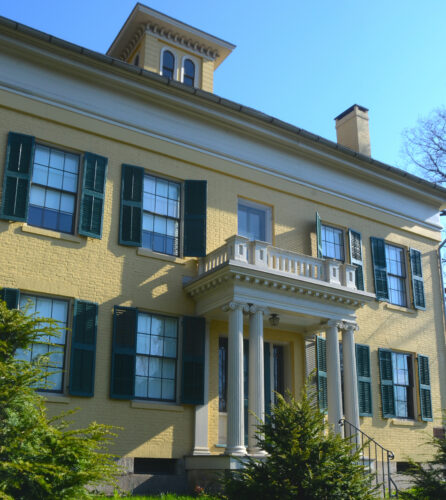
The front facade of the Homestead

A Virtual Tour of
the Homestead and The Evergreens

The front facade of the Homestead

The Homestead, built in 1813.

Over the course of her life in Amherst, Massachusetts, Emily Dickinson forged her powers of creativity and insight in the intimate environs of her beloved home, creating extraordinary poetry that touches the world. The poet’s daily life became the spark for extraordinary writing and her home proved a sanctuary for her boundless creative energy that produced almost 1,800 poems and a profusion of vibrant letters. Here, Dickinson fully embraced her unique personal vision, leaving behind a poetic legacy that is revolutionary in form and substance. Today, her voice and her story continue to inspire diverse audiences around the globe.

Visitors to the Emily Dickinson Museum explore the Homestead, where Dickinson was born, died, and did most of her writing, and The Evergreens, home of the poet’s brother, sister-in-law, and their three children. The Homestead, lived in by other families after Dickinson’s death, is in the process of being restored to its appearance during the poet’s writing years. The Evergreens was only ever lived in by Dickinsons or family heirs and its original 19th-century finishes remain intact. Dickinson’s life story and the story of her posthumous publication is uniquely entwined with these two houses and the three acres upon which they sit in Amherst.

BEGIN YOUR EXPLORATION

In this online exploration, you will visit several rooms within the two houses of the Dickinson family. Along the way you will see video and photographs of these historic spaces and learn more about how the poet’s life unfolded here. You will meet friends and family members, and encounter Dickinson’s own words quoted from extant poems and letters. Wherever you are, we hope this virtual exploration transports you to Emily Dickinson’s Amherst home.
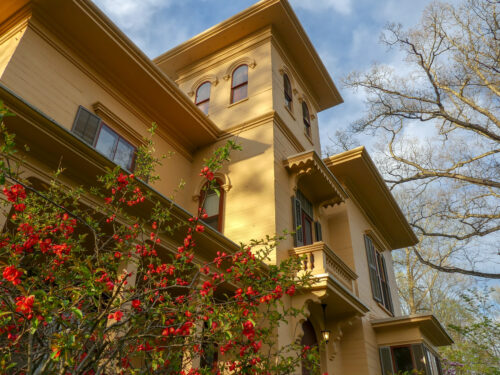
The exterior of the 2nd floor of the Evergreens viewed from the ground

The Evergreens, built in 1856


Long Years apart – can make no
Breach a second cannot fill –
The absence of the Witch does not
Invalidate the spell –

The embers of a Thousand Years
Uncovered by the Hand
That fondled them when they were Fire
Will stir and understand

Fr1405


The Virtual Exploration of the Homestead and The Evergreens has been made possible in part by a grant from Mass Humanities and the generous support of Nicole P. Heath and of Susan R. Snively.

Mass Humanities logo