the exterior of Emily Dickinson's yellow house on a sunny day

A House That Reveals a Poet

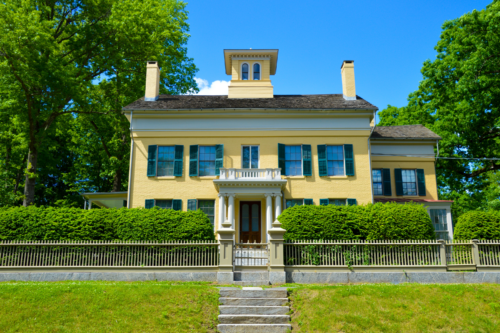
the exterior of Emily Dickinson's yellow house on a sunny day

Between the Dashes #3 – An Emily Dickinson Museum Blog  • August 19, 2026 

This guest post is authored by Mary A. van Balgooy and was originally and independently published in Engaging Places, a design and strategy firm that connects people and historic places. 

The Emily Dickinson Museum is grateful for feedback from visitors like Mary and deeply appreciated her insights on our tour. 

A House That Reveals a Poet
By Mary A. van Balgooy

Before visiting the Emily Dickinson Museum in Amherst, Massachusetts, I knew surprisingly little about Emily Dickinson. The Museum encompasses two historic houses: the restored Homestead, where Dickinson was born, died, and wrote most of her poetry, and the unrestored Evergreens, the neighboring home of her brother Austin, his wife Susan, and their family. Although the Museum includes both houses, it was the Homestead that demonstrated how a historic house can become the key to understanding a poet.

I knew Emily Dickinson was one of America’s greatest poets, that she published very little during her lifetime, and that she lived much of her adult life in relative seclusion. I was also familiar with a few of the recurring stories surrounding her life—her correspondence with Thomas Wentworth Higginson, her close relationship with her sister-in-law Susan Gilbert Dickinson, and the questions surrounding her withdrawal from society. Beyond that, she remained something of a mystery. What I did not expect was that the house itself would become the key to understanding her.

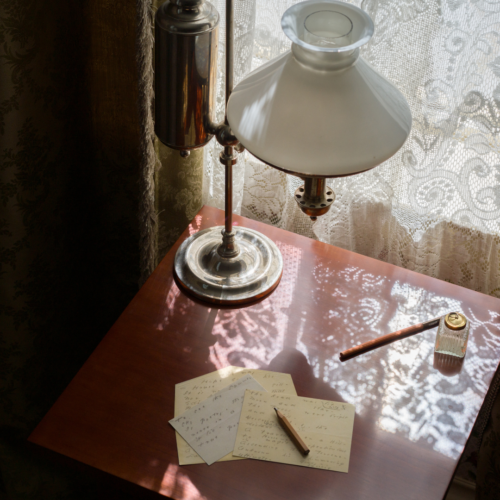
Dickinson's writing desk with pens, scraps of paper and her lampMany literary house museums preserve the places where authors lived and worked. The Emily Dickinson Homestead does something more ambitious. Rather than treating the Homestead simply as the place where Emily Dickinson lived, the guide used the house as a framework for understanding the person behind the poet. Each room served as a setting for exploring a different aspect of her life. This was done not through dates and events alone, but through her own poetry, her education, her family relationships, her intellectual curiosity, and her creative choices. In doing so, the house became not simply the setting for Dickinson’s story but an essential part of telling it.
Instead of beginning with furniture or architecture, the guide frequently began with one of Dickinson’s poems. Often, one of Dickinson’s poems opened a conversation, and the room became the backdrop for understanding the experiences, questions, and relationships that informed her writing. The library became a place to discuss education and the books that expanded her thinking. Her bedroom became a place to examine the extraordinary burst of creativity that produced more than a thousand poems in just a few years. Family spaces became opportunities to explore the network of people who made her work possible—from her father, who supplied books; to her sister Lavinia, who assumed many household responsibilities; to sister-in-law Susan, her closest reader and intellectual companion. The result was a tour that never reduced Dickinson to either biography or legend. It was one of the most effective literary house tours I have experienced.

What impressed me most was the guide’s willingness to embrace uncertainty. Rather than presenting tidy answers, she repeatedly acknowledged where historians continue to debate Dickinson’s life. Why did she withdraw from much of Amherst society? What was the nature of her relationship with Susan Dickinson? How should we understand her religious beliefs? Instead of resolving these questions, the tour demonstrated that uncertainty itself was central to Dickinson’s way of thinking. She resisted simple conclusions in both her life and her poetry, and the interpretation respected that complexity.

The house itself became more than a collection of historic rooms. It became evidence of the environment that shaped Dickinson’s intellectual and creative life. Visitors could see the spaces where Dickinson read, wrote, observed, questioned, and developed the distinctive poetic voice that challenged nineteenth-century literary conventions. The physical setting helped explain not simply where she lived but how her intellectual world was formed.

That approach sets the Homestead apart. Many literary house museums understandably focus on the author’s daily life or preserve rooms much as they appeared during the occupant’s lifetime. The Dickinson Homestead certainly does that, but it goes further. The furnishings and objects rarely become ends in themselves. Instead, they serve the larger goal of helping visitors understand the development of a remarkable mind.

By the end of the tour, I realized I wanted to do something I had not expected: read more Emily Dickinson. Not because I felt obligated to appreciate a famous poet, but because the tour made me curious. It introduced Dickinson not as an icon frozen in history but as an endlessly questioning thinker whose poems continue to reward careful reading.

That may be the highest compliment one can give a literary house museum. It did not simply teach me about Emily Dickinson. It made me want to know her better.

Historic house museums often ask visitors to imagine what life was like within their walls. The Emily Dickinson Homestead accomplishes something more difficult. It uses the house, its objects, and Dickinson’s own words to illuminate the experiences, ideas, and relationships that shaped one of America’s greatest poets. Emily Dickinson remains unknowable in many respects—as all remarkable people do—but I left feeling that I understood not simply more about her life, but more about the mind that produced her poetry.

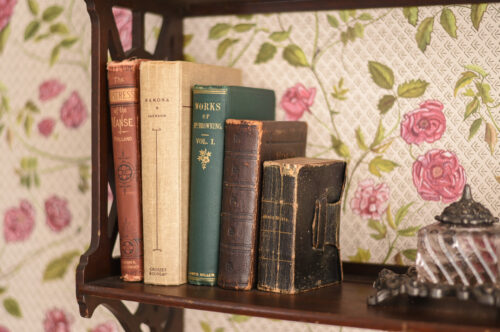
a close up of books on dickinson's shelf

From a Garage Sale to Emily Dickinson’s Bedroom

Rebuilding the Dickinson’s Library

close-up of a shelf in Dickinson's bedroom with a few books and an inkwell

As Dickinson scholar Polly Longsworth once noted:

“Books were a source of pride, pleasure, discussion, and even competitiveness among family members. Few possessions meant so much.”

The Emily Dickinson Museum is inviting you to become a part of literary history. We have officially relaunched Replenishing the Shelves, a unique, participatory collections initiative that asks book lovers around the world to help track down and reunite the exact book editions that once filled the Dickinson household.

You might be wondering: where did all the original books go?

Books from the Homestead and The Evergreens libraries that had close association with the poet became the gifted property of Harvard University in 1950. The remainder of the libraries of both houses was transferred in the early 1990s to the John Hay Library at Brown University. 

The Emily Dickinson Museum knows the exact titles, publishers, and publication years of the books the family owned because the originals are preserved within these prestigious institutional archives. This also means that the shelves at the Homestead in Amherst have some empty spaces. 

The Museum’s goal is to find those exact matching editions and bring them back to the rooms where they were first read and cherished.

Incredible discoveries are happening in the most unexpected places.

Ashtyne Wallingsford from Portland, Texas is a self-described lifelong “book nerd,” Ashtyne has always been drawn to old classics, first editions, and books bearing personal inscriptions. Recently, she made a casual stop at a local garage sale and noticed a box of older books. Tucked inside were two copies of Saxe Holm’s Stories (first series) by Helen Hunt Jackson, published in 1886.

Intrigued by her find, Wallingsford began researching the author and publication year online. Her digital deep-dive led her straight to the Emily Dickinson Museum’s Replenishing the Shelves list, where she realized the book she had found might be something more than a personal treasure.

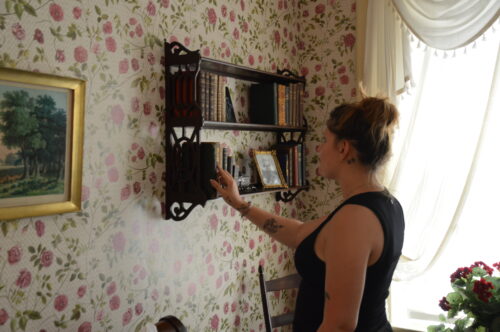
a person places a book on the shelf next to Dickinson's bedroom

After double-checking the edition to ensure it was the correct year, she reached out to the Museum’s Collection Manager, Megan Ramsey. Through photographs, the Museum confirmed that this was indeed a specific edition they had been hunting for.

Though Wallingsford hadn’t originally intended to give the book away, the thought of returning it to its historic home changed everything. “Letting it be part of shared knowledge felt really important,” she said. “I feel grateful that I was able to provide this to the Museum and contribute to better understanding history.”

When Wallingsford later traveled to Amherst to visit the Museum, she got to do something most history buffs only dream of: walking into Emily Dickinson’s bedroom and personally placing the book on the shelf right next to the poet’s bed.

“Getting to place the book on the shelf in the bedroom felt crazy,” Wallingsford shared. “Knowing that something I donated is right there next to Dickinson’s bed… I’m speechless.”

Your Invitation to Replenish the Shelves

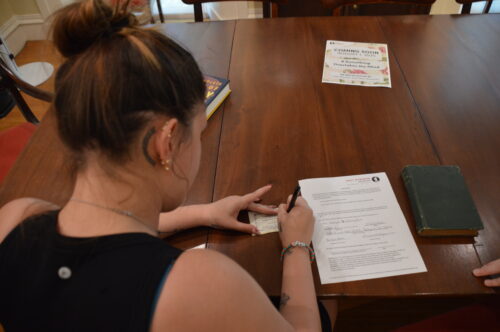
a person signs a donation agreement for the replenishing the shelves project

Stories like Wallingsford’s underscore the importance of this crowdsourced project: history is not only preserved by large institutions, but through the vital support of passionate individuals. By reuniting books in Dickinson’s home, the Museum continues to build a living, evolving collection.

The project originally launched in 2007 to honor Polly Longsworth, the first chair of the Museum’s Board of Governors. This exciting relaunch coincides with recent digital collections upgrades at the Museum and has received significant additional support through a generous gift from Charles and Polly Longsworth. Thanks to these new digital search tools, it is now easier than ever for the public to see exactly which titles are missing, how to identify the correct editions, and how to donate them.

The next time you are browsing a thrift shop, an estate sale, or even your own family’s attic, keep your eyes peeled. You might just find a treasure that belongs on Emily Dickinson’s bedside table.

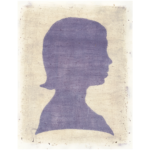
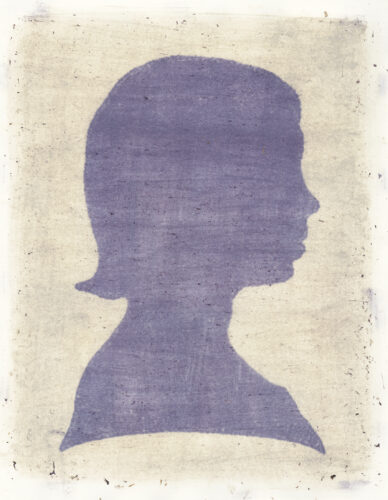
a purple version of Dickinson's side profile as a child

Dickinson’s Herbarium Reimagined


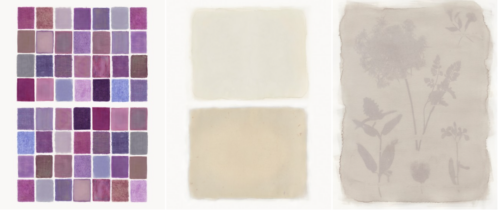
3 artworks as part of this earthen door

This Earthen Door Amanda Marchand and Leah Sobsey

Between the Dashes #1 – An Emily Dickinson Museum Blog  • June 17, 2026 

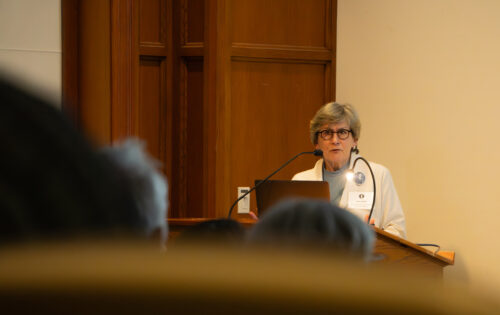
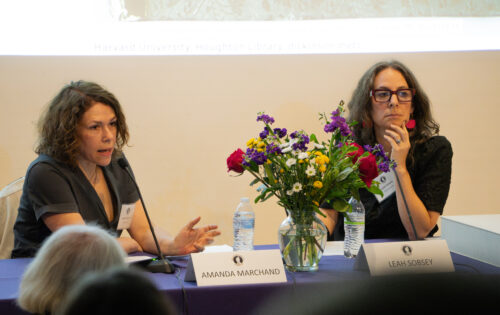
On Friday, May 29, the Emily Dickinson Museum hosted a special Amherst College Reunion program, “This Earthen Door: An Anthotype Homage to Emily Dickinson.” The one-hour illustrated lecture featured contemporary artists Amanda Marchand and Leah Sobsey presenting their collaborative project and book, which blends historical archives, plant-based photography, and ecological activism.

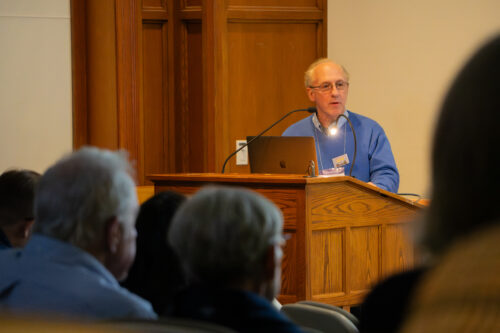
Introduced by Jane Wald, the Museum’s Jane and Robert Keiter Family Executive Director, and Museum Trustee Christopher Bogan (’76), the event highlighted how historical archives can serve as living resources to navigate modern environmental challenges.

“During my 24 years with the Museum, a portion of my work has involved restoring Emily Dickinson’s home, preserving its contents, and eventually re-establishing more of her garden. Our goal in recovering the physical and cultural contexts of her life is to illuminate the origins and power of her poetry and to share the spark of creativity in all who encounter her work.”

Reanimating History Through Anthotypes

Amanda Marchand and Leah Sobsey
Red Daylily, Emily at 14 - negative 
(from silhouette of Dickinson cut by Charles Temple 1845)

Amanda Marchand and Leah Sobsey
Red Daylily, Emily at 14 – negative
(from silhouette of Dickinson cut by Charles Temple 1845)

This Earthen Door  is an eco-feminist collaboration that reanimates Emily Dickinson’s herbarium for the 21st century. Marchand and Sobsey remade Dickinson’s original herbarium pages using anthotypes, a plant-based photographic process developed during the poet’s era.

The artists extracted pigments from plants they grew and harvested by hand—the exact species that Dickinson herself cultivated or collected in the nearby woods and meadows of Amherst, Massachusetts. The project involved intensive studio practice and collaborative research with botanists.

By focusing on this intersection of art and science, This Earthen Door underscores the enduring relevance of archives while shedding light on the historically overlooked scientific and artistic contributions of women. The artists remind us that historical archives are not static. Instead, they are living resources that can help us navigate our shared ecological future.

Reflecting on Dickinson’s poem, “New feet within my garden go — / New fingers stir the sod —” (FR 79), Wald noted that Marchand and Sobsey’s work represents a perfect modern realization of those “new fingers” interacting with Dickinson’s legacy.

In a time marked by widespread climate anxiety and ecological instability, the artists’ work asks a vital question: How can a renewed, tactile attention to plants reshape our understanding of the present moment—and our shared futures?


Jane Wald, Emily Dickinson Museum Keiter Family Executive Director

Jane Wald, Emily Dickinson Museum Keiter Family Executive Director

Chris Bogan, Emily Dickinson Museum Board Member

Chris Bogan, Emily Dickinson Museum Board Member

two artists presenting at a lecture

Amanda Marchand and Leah Sobsey, artists


About the Artists

Leah Sobsey is an award-winning artist and Associate Professor of Photography at the University of North Carolina, Greensboro. Her multidisciplinary photographic practice reaches into the fields of science, design, and installation. Specializing in plant-based printing techniques, her experimental photo-based work explores the natural world through archives and taxonomies. Learn more at leahsobsey.com.

Amanda Marchand is a Canadian, New York-based photographer, educator, and writer whose practice explores the environment, landscape, and experimental, plant-based photographic processes. She uses an experimental approach to photography to investigate the natural world and our changing climate. Learn more at amandamarchand.com.