
For Immediate Release
Contact:
Patrick Fecher
publicrelations@emilydickinsonmuseum.org
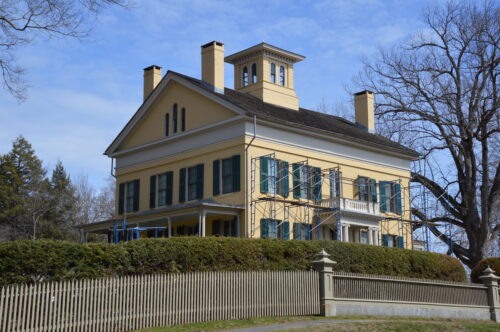
Construction Underway: The Emily Dickinson Museum Replaces Roof and Begins Research Stage for Final Homestead Restoration
(AMHERST, MA, March, 30, 2026) – The Emily Dickinson Museum has announced the commencement of a critical phase in its ongoing restoration efforts: the forensic study of the Homestead’s east and north additions. This meticulous process serves as the investigative prelude to a full-scale restoration of two wings of the nineteenth-century home where most of the family’s domestic labor took place.
“When the final phase of restoration is complete,” said executive director Jane Wald, “the Museum will have achieved one of the important goals it set for itself in 2003: returning the poet’s home – as faithfully as possible – to its appearance during the years she lived here and wrote nearly all of her striking and lasting poetry.”
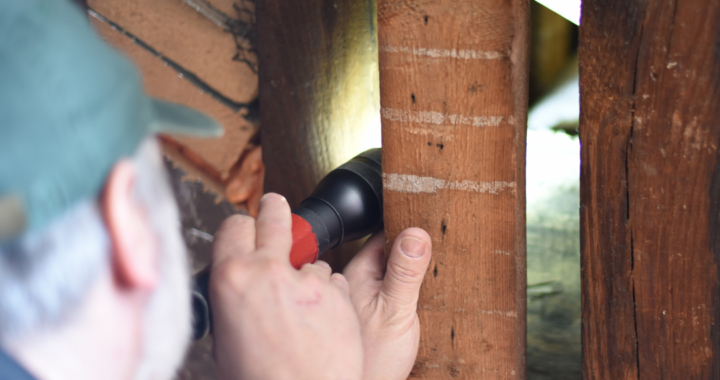
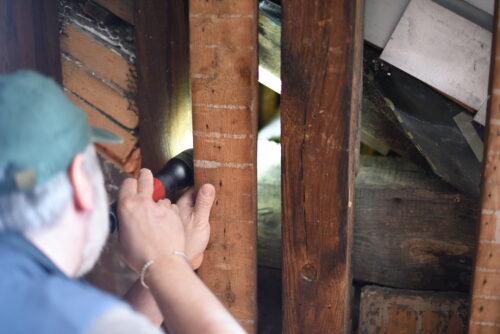
Investigation of the building fabric is a forensic process of examining the sequence of changes that various owners have made over time. Akin to archaeology, it requires careful dismantling of specific modern architectural additions to or alterations of the Homestead, including gypsum drywall or dropped ceilings, to expose original nineteenth-century features such as original plaster walls or room divisions. This is a vital stage in restoration as the north and east wings were built during Emily Dickinson’s lifetime, modified both during her lifetime and after her death.
The Emily Dickinson Museum is working with Mesick Cohen Wilson Baker Architects to provide guidance about material to remove and Teagno Construction, Inc., to perform the work of revealing nineteenth-century features. The two firms previously were instrumental in the restoration of the original 1813 portion of the Homestead from 2021 to 2024.
“There are hints, to be confirmed by this research, about how domestic space and activities were organized in Emily Dickinson’s lifetime,” Wald explained. “The Museum will use the results of this ‘building archaeology’ to help uncover and highlight the lives of the many individuals who worked for the Dickinson family and supported their more recognized accomplishments.”
In addition to restoration research, the Emily Dickinson Museum is set to replace the cedar shingle roof on the circa 1813 main block and the circa 1840 east addition. In 1916, when the Homestead was sold out of the Dickinson family, new owners replaced the dilapidated nineteenth-century roof with new slate roofing materials. In examining the roof for necessary maintenance in 2000, it was discovered that the heavy slate had caused deflection in the beams and plates supporting the roof. To prevent further structural damage and to return to the materials present during the poet’s lifetime, slate was replaced with cedar shingles. Now, after twenty-five years, new cedar shingles will replace the worn and weathered material.
Both projects are beginning at the end of March and are expected to be complete by the end of May 2026. During this time, the Emily Dickinson Museum will continue to be open to the public Wednesday through Sunday, 10am-5pm. Pedestrian paths and the visitor entrance to the Homestead may be re-routed for convenience and safety.
For additional photography, please contact publicrelations@
ABOUT THE EMILY DICKINSON MUSEUM
The Emily Dickinson Museum is dedicated to sparking the imagination by amplifying Emily Dickinson’s revolutionary poetic voice from the place she called home.
The Museum comprises two historic houses—the Dickinson Homestead and The Evergreens in the center of Amherst, Mass.—that were home to the poet (1830-1886) and members of her immediate family during the nineteenth and early twentieth centuries. The Museum was created in 2003 when the two houses merged under the ownership of the Trustees of Amherst College. The Museum is overseen by a separate Board of Governors and is responsible for raising its own operating, program, and capital funds.