
IN-PERSON PAINTING EXHIBITION
On view Tuesday, November 10
“That without suspecting it you should send me the preferred flower of life, seems almost supernatural.”
The installation is free to the public during the Museum’s open hours and will be on view beginning November 10.
The joint exhibition will open on Tuesday, November 10, Mabel Todd’s 170th birthday, 5:30 to 7:30 pm at both the Emily Dickinson Museum at 280 Main Street and the Amherst History Center, the Society’s satellite location at 45 Boltwood Walk, just a five-minute walk from each other. Participants are encouraged to begin their evening at the Amherst History Center where opening remarks will occur at 6:00 pm. A shuttle between sites will be running between 6:15 pm and 7 pm. The public is warmly invited to attend; refreshments will be provided.
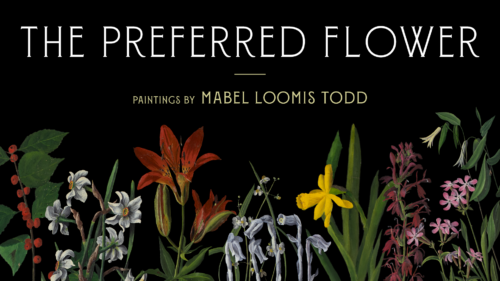
The Emily Dickinson Museum and the Amherst History Center are pleased to announce The Preferred Flower, an exhibition illuminating the expressive botanical paintings of Mabel Loomis Todd (1856–1932). Best known as the primary editor of Emily Dickinson’s posthumously published poetry, Todd was also an accomplished painter whose vivid renderings of flowers captured the natural world with precision and vitality.
The exhibition title originates from an 1882 letter Emily Dickinson wrote to Todd after receiving a painting of “Indian Pipes” (Monotropa uniflora): “That without suspecting it you should send me the preferred flower of life, seems almost supernatural.” A few days later, Dickinson followed up with one of her favorite poems “A Route of Evanescence” indicating “I cannot make an Indian Pipe but please accept a Humming Bird.” Todd’s “Indian Pipe” illustration went on to grace the cover of every 19th-century edition of Dickinson’s poetry.
The exhibition features eighteen floral studies, including detailed renderings of Monotropa uniflora, trailing arbutus (Epigaea repens), cardinal flower (Lobelia cardinalis), fringed gentian (Gentianopsis crinita), arrowheads (Sagittaria latifolia), wild mountain pinks (Silene caroliniana), bellwort (Uvularia perfoliata), witch hazel (Hamamelis virginiana), and more. The 18 paintings on view were donated to the Emily Dickinson Museum by Cinda Jones. Nine of the paintings will be on view at the Emily Dickinson Museum and nine at the Amherst History Center on Boltwood Walk.
ABOUT MABEL LOOMIS TODD
Writer, editor, lecturer, traveler, conservationist and artist. Mabel Loomis Todd (1856–1932) exercised her agile curiosity across the fields of literature, science, nature, and the visual arts. Best known today for her influential role in bringing the poetry of Emily Dickinson to the public, Todd also pursued creative work of her own. Her small botanical oil paintings, in particular, offer an intimate glimpse into an artistic habit of a lifetime.
Born in Washington, D.C., Todd attended Georgetown Female Seminary, then studied voice and piano at the New England Conservatory of Music in Boston where she also cultivated her talent for flower-painting and writing. Returning to Washington, she married astronomer David Peck Todd and moved with him to Amherst, Massachusetts, in 1881. There she joined a lively Amherst College intellectual community enriched by the vivid natural landscape of the Connecticut River Valley. Her interests and causes were remarkably broad. She accompanied her husband on scientific expeditions; traveled widely; wrote about her travels, astronomy and other subjects; lectured publicly on all these topics; and cultivated a lifelong engagement with the arts. Her contributions to the town of Amherst included founding roles with the Amherst Historical Society, the Amherst Woman’s Club, and the local chapter of the Daughters of the American Revolution.
Upon her arrival in Amherst, Mabel Todd became closely connected with the Dickinson family as a friend of Emily’s sister Lavinia and as a romantic partner of Emily’s brother Austin. Although Todd and Dickinson never met face to face, their brief correspondence demonstrates a shared interest in the natural world expressed through their respective talents as artist and poet. Following Emily Dickinson’s death in 1886, her sister Lavinia entrusted Todd and co-editor Thomas Wentworth Higginson, a prominent literary figure and correspondent of Dickinson, with preparation of a collection of poems for publication. Adorned with Todd’s illustration of monotropa uniflora, the first volume appeared in 1890, bringing Dickinson’s writing to a wide readership. Todd subsequently edited additional collections of poems and letters, which established Dickinson’s early public reputation.
This exhibition is made possible thanks to a donation from Cinda Jones.
The Emily Dickinson Fund provides for the Museum’s day-to-day operations, undergirds its highest priorities, and is foundational to its overall excellence and success. The Fund supplies 36% of our operating budget. Your gift has an immediate impact and provides critical, unrestricted support. Every donor and every gift sustains and elevates the Museum’s mission for generations of admirers to come. Learn more about how you can support the Museum.