
HYBRID PROGRAM — in-person at the Emily Dickinson Museum and streaming live for online registrants
This program is FREE to attend. Registration is required.
Part of the 2024 Tell It Slant Poetry Festival!
Join us for the 12th annual Tell it Slant Poetry Festival, a week of events happening both online and in-person at the Museum! Register here to access the Festival schedule:
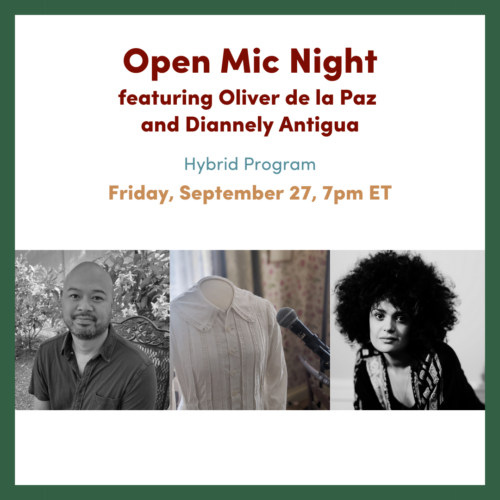
Open mic night hosted by poets Oliver de la Paz and Diannely Antigua.
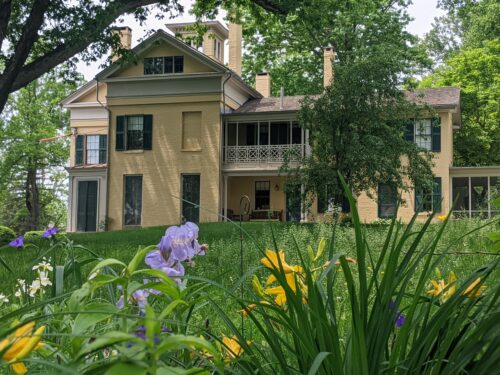
Bring your poems to Emily Dickinson’s garden! Readers will have 5 minutes each to make us feel “physically as if the top of [our] head[s] were taken off!” (Emily Dickinson to Thomas Wentworth Higginson, 16 August 1870) Featured poets Oliver de la Paz and Diannely Antigua will follow the open mic. Open mic sign-ups are handled in advance via a Google Form, and selected readers will be notified. All readers must be available to read in-person and must register for the Festival to be considered.
Sign-ups for open mic readers have now closed.
About the Poets
Oliver de la Paz is the author and editor of several books and serves as the Poet Laureate of Worcester, MA. His latest collection of poetry, The Diaspora Sonnets, was published by Liveright Press (2023). It was a winner of the 2023 New England Book Award and was longlisted for the 2023 National Book Award. A founding member of Kundiman, he teaches at the College of the Holy Cross and in the Low-Residency MFA Program at PLU.
oliverdelapaz.com
Support The Tell It Slant Poetry Festival and Honor Someone Special:
Admission to all Festival events is free, but online donations, especially those made in honor or memory of family, friends, or colleagues are heartily encouraged and vital to the future of this beloved annual event. All gifts are tax deductible and will be recognized as part of the Festival.
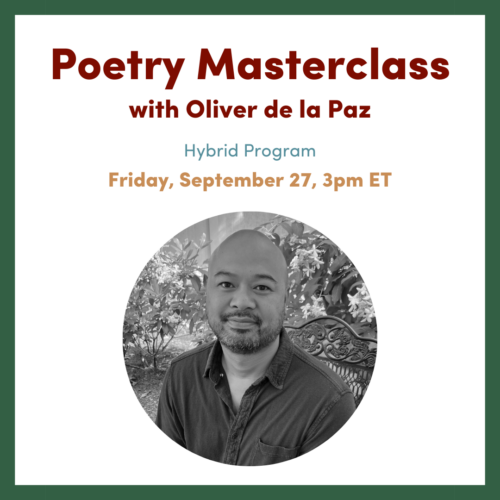 From invention to revision, this generative workshop will attend to the possibilities of creating new work that is in-tune with a subject that haunts you. We will be looking at how to write and sustain work within a singular focus, obsession, or motif. This workshop introduces poems and works paired with exercises that allow the writer to be haunted by a subject, inviting writers to seek new possibilities, and perhaps provide outlets to future projects and poems. We’ll explore models of poems and hybrid works by authors that find themselves, suddenly facing the ghosts that visit them frequently. Ultimately, we will look to lines from Dickinson that declare:
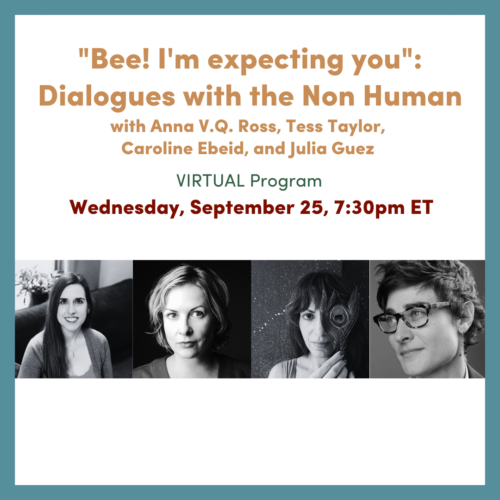 Like us, Emily Dickinson lived in a time of ecological change and painful civil conflict. Against this backdrop, Dickinson’s poems reach out to the world around her—the frog, the snake, the hummingbird, train, “slant of light,” even the “loaded gun,” addressing these others as companions, fellow witnesses. In this panel, poets Carolina Ebeid, Julia Guez, Anna V. Q. Ross, and Tess Taylor will explore both Dickinson’s and their own dialogues with the nonhuman. The poets will read poems by Dickinson in conversation with each other’s work to plumb that site in which “surpassing/Material Place—” we might instead “Dwell in Possibility.” We follow with writing prompts and conversation.
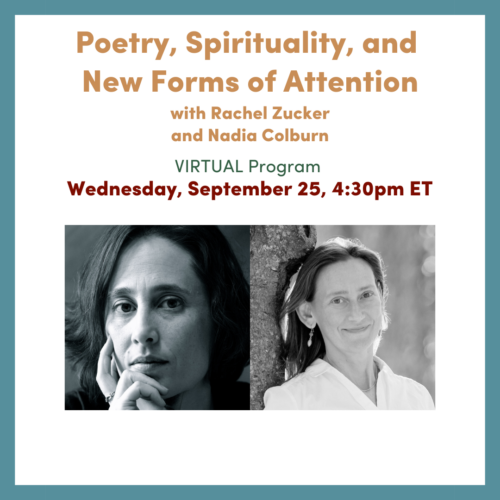 Emily Dickinson’s poems interact with silence to open spaces of questioning, recognition, and keen attention to spiritual matters and questions of meaning. In this workshop, we’ll place our own poetry in the context of Dickinson’s poetry, offer a short guided meditation and generative prompts for participants to explore their own relation to silence, voice, and spiritual attention.
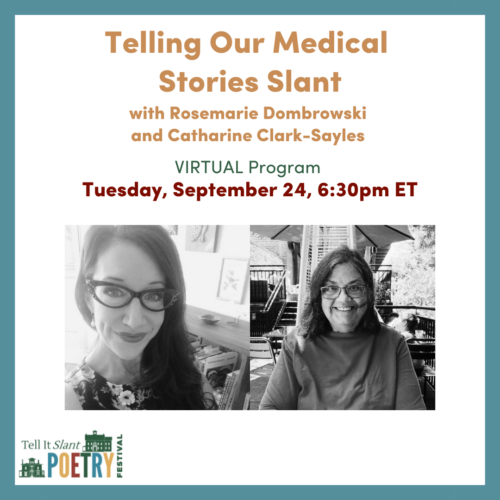 SOLD OUT! — This program has reached maximum registrant capacity. We hope you’ll register for other Festival programs!
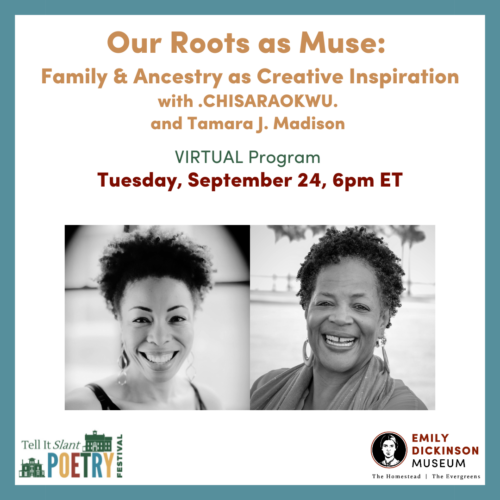 Facilitators will lead participants in a series of generative writing exercises using personal family and ancestral history as creative inspiration and content. The workshop will allow time for writing and limited time for sharing excerpts in breakout rooms. Participants will leave the workshop with at least two writing sketches and other writing resources to continue developing their ideas and creatively archiving their own family histories.
 For any questions, please e-mail
 Thursday, August 22, 2024
 Thursday, September 12, 2024
 Thursday, October 16, 2024
 Thursday, November 21, 2024